
2026 Free Agent Evaluation: Eugenio Suárez

Player: Eugenio Suárez
Age: 34 | DOB: 7/18/1991
B/T: R/R | H/W: 5’11” / 213
Pos: 3B/DH
Service Time: 11.061 | Agent: Octagon
I am messing around with the format of the player evals. I am using the ‘Playing Assistant GM’ section as a way to tell a story about the player. The analysis/findings/recommendation will occur in the ‘Playing Assistant GM’ section. The first part is mostly all data, and I include it incase readers want to look at it.
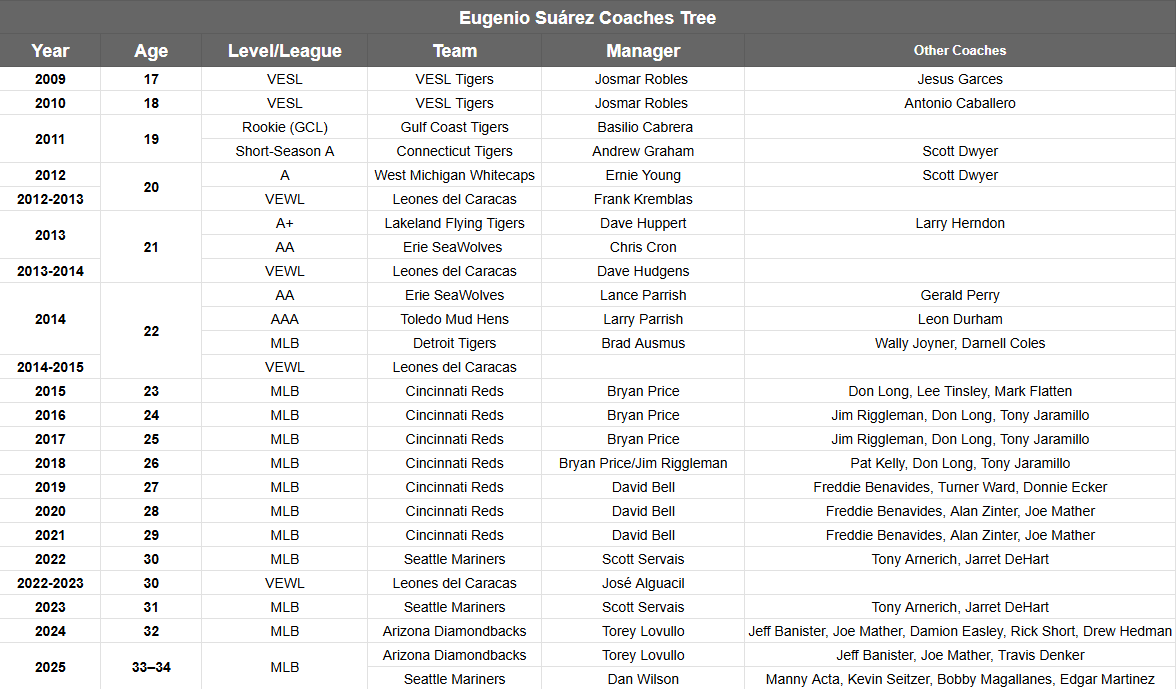
Playing History & Coaches Tree
Availability
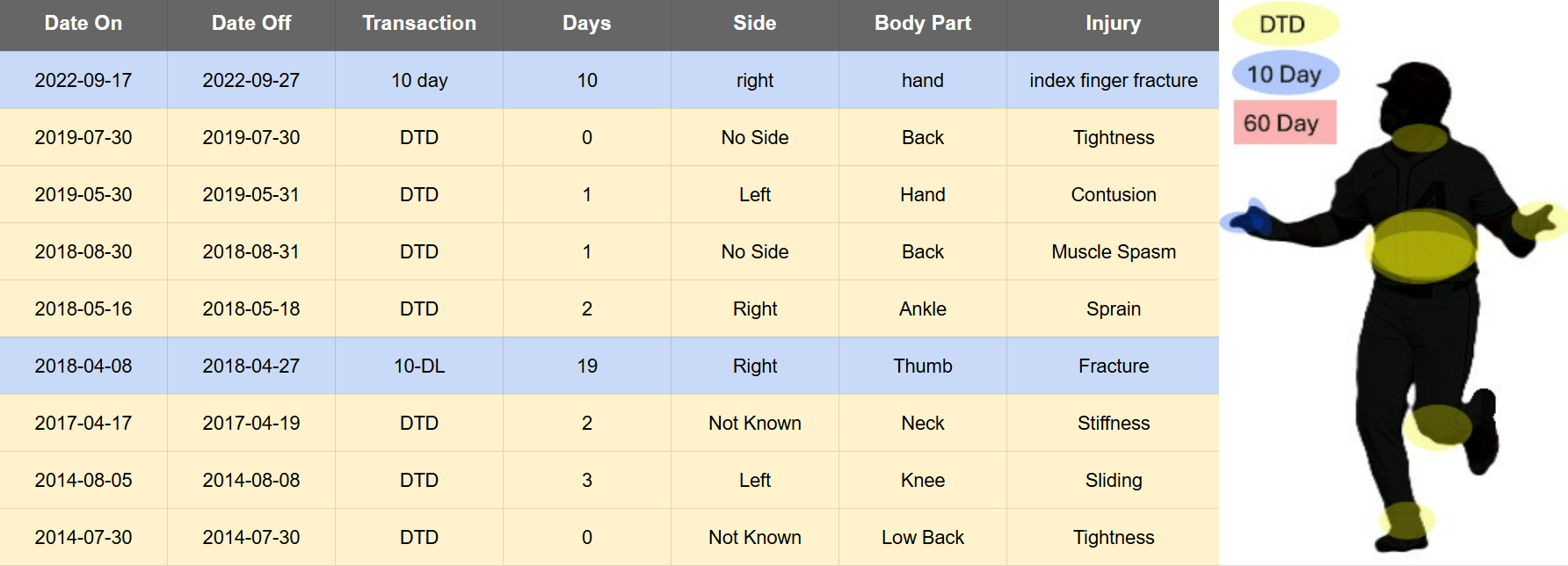
Injury Report
Speed

Defensive Profile

Offensive Report Card
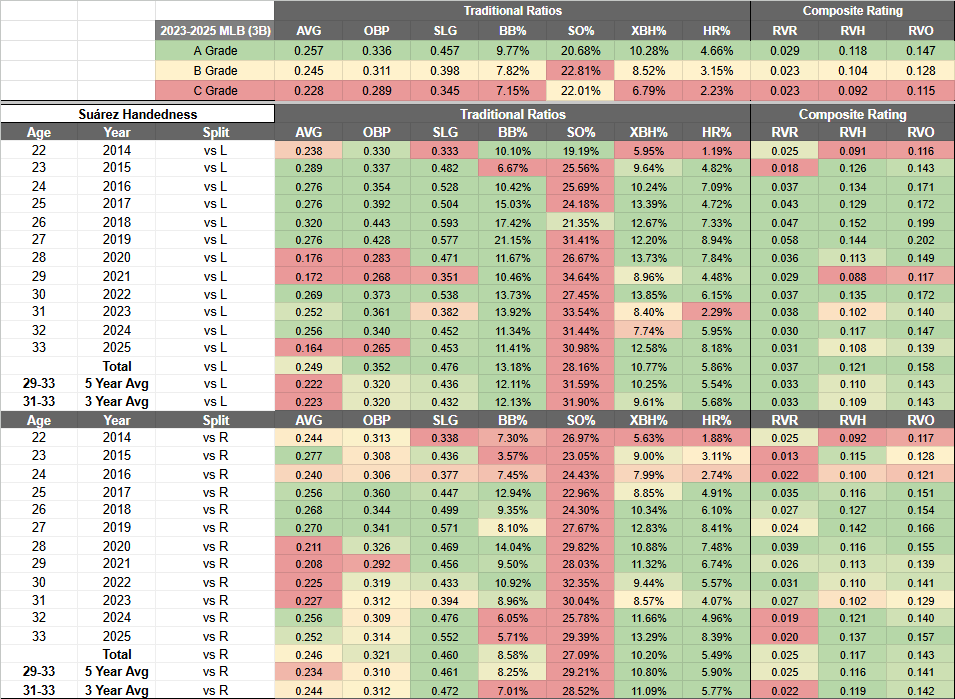
There are plenty of ways to evaluate offensive production. For this review, I’ll measure Eugenio Suárez against his positional peers using an A-B-C grading scale. Specifically, I’ll compare him to the average A Grade (1–10), B Grade (11–20), and C Grade (21–30) player at his position. In Suárez’s case, his positional comp is Third Base (3B).
I use the A-B-C Grading System because it’s easy for a broad audience to understand. While it could be expanded into subgrades A+, A, A- (Elite, Great, Good); B+, B, B- (Above Average, Average, Below Average); and C+, C, C- (Well Below Average, Not Good, Not Great) I keep it simple here for the sake of space and clarity. Sometimes I do use these terms interchangeably.
If some of the stats look unfamiliar, welcome to Bozzy Baseball Blogs. My background is in both baseball and insurance underwriting/finance, and I’ve developed my own version of a run value system to measure offensive production. It’s an end result, neutralized Run Value system, broken down into two core components:
RVR (Run Value Running) “The Run Tool”— Captures the value generated from non-hit plate appearances
RVH (Run Value Hitting) “The Hit Tool”— Measures a player’s offensive impact via hitting
RVO (Run Value Overall) “Overall” — The sum of Run Tool + Hit Tool, representing overall offensive contribution per plate appearance
I received some feedback from a reader and they had some questions about what the rates “Hit Tool” “Run Tool” “Overall Rate” mean and how it works…
So every offensive event has a run value associated with it, and I am breaking that down to a per Plate Appearance Basis. Some readers may ask why don’t you just look at RBI and Runs Scored to determine run value? Well, that’s a good point, but not every team is created equal. Some teams are juggernauts and other are well…not juggernauts, F Tier. If you play on better teams you will have more opportunities to score runs and drive more batters in so it would be “unfair” to judge players using traditional RBI and Runs Scored stats.
My goal was/is measure each players contributions individually and to create a practical statistic. One of the frustrations I have with traditional baseball stats is they do not have much practical use. Does do WAR, OPS, wOBA, etc. really have a use case? Not really. So I give every baseball event has a predetermined set run value. I then break those value down into the Hit Tool Rate (1B,2B,3B,HR) + Run Tool Rate (BB, SB, HBP) = Overall Rate by Plate appearance.
The first split on the Report Card is Career Totals. This is the widest stat lens, breaking down yearly totals. This provides a valuable look into possibly larger trends year-to-year.
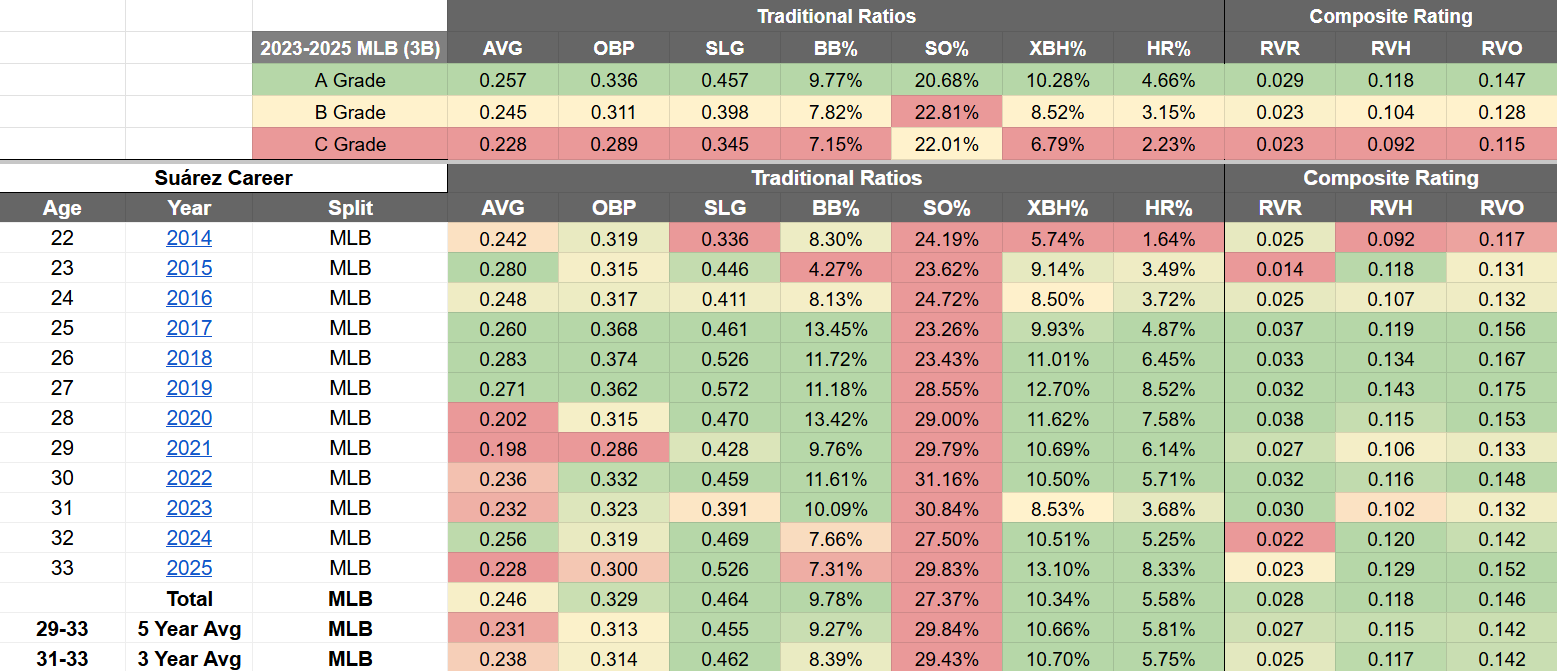
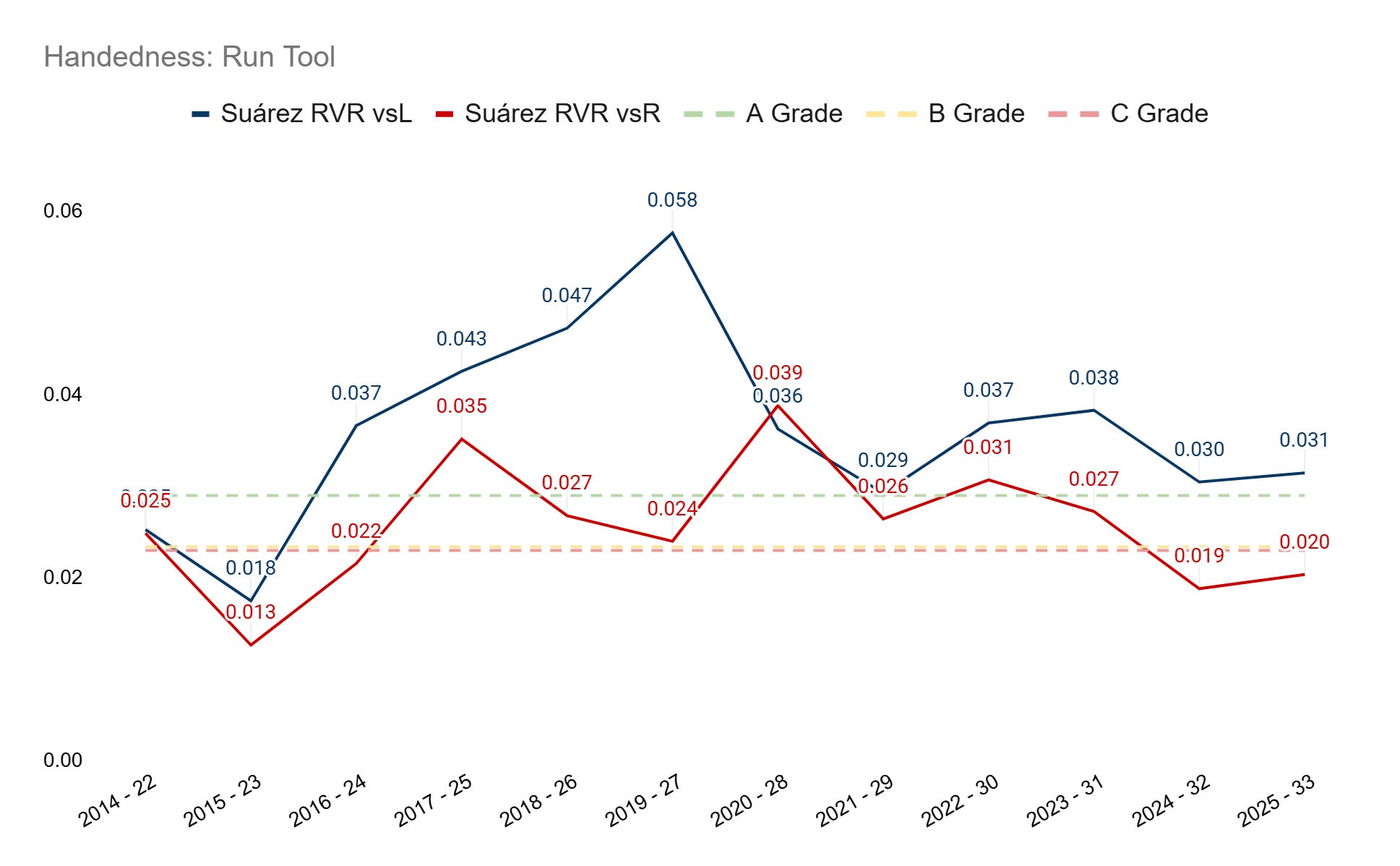
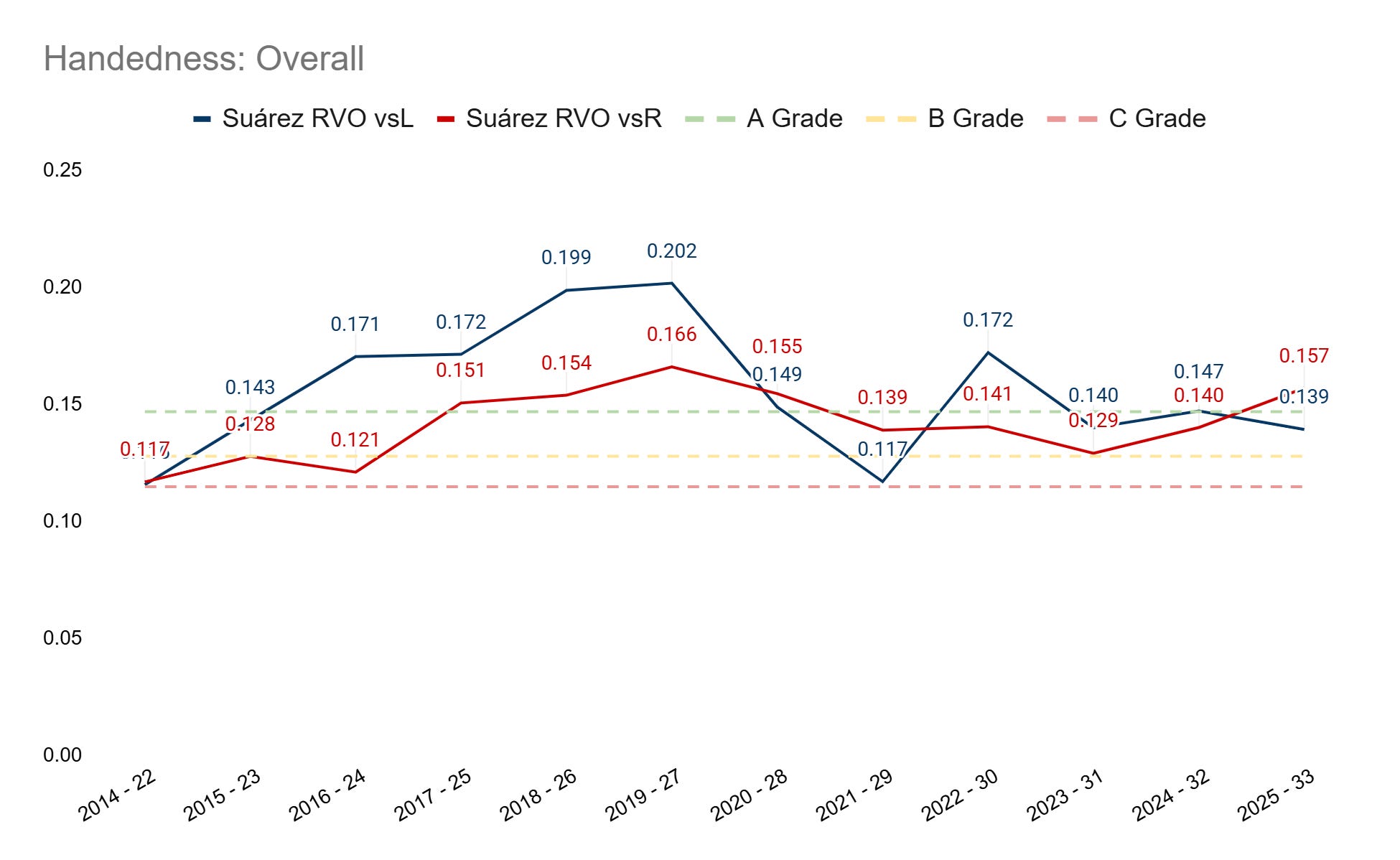
Handedness - vs. RHP & LHP - Still a wide lens, but splitting the totals by LHP & RHP. This provides a valuable look into possible larger trends against left handed and right handed pitchers. One of my favorite splits to look at. This was a pivotal split last year when evaluating Tyler O’Neill.
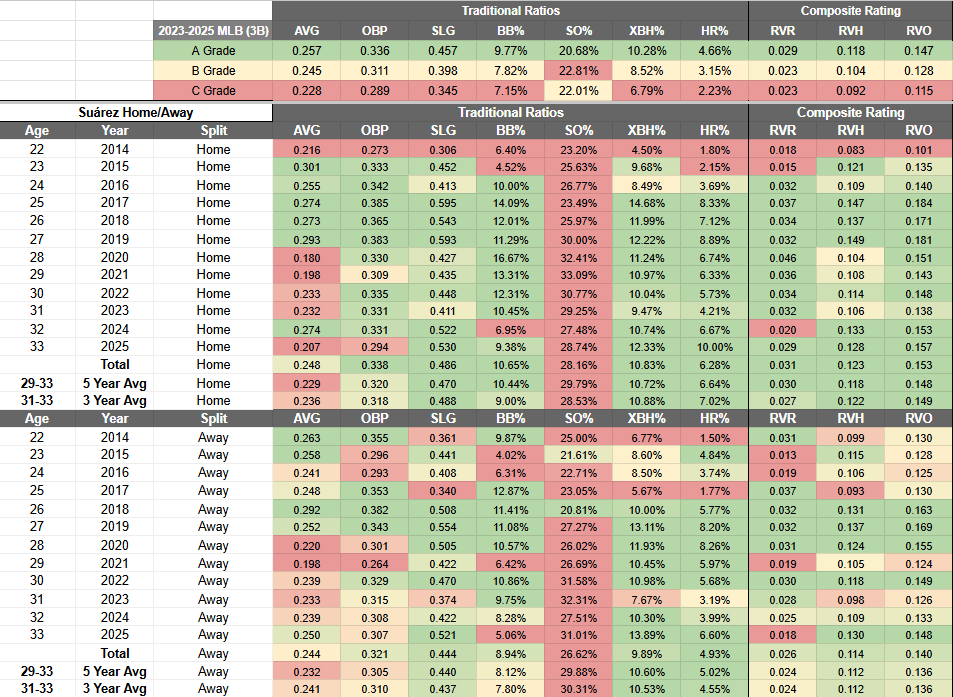
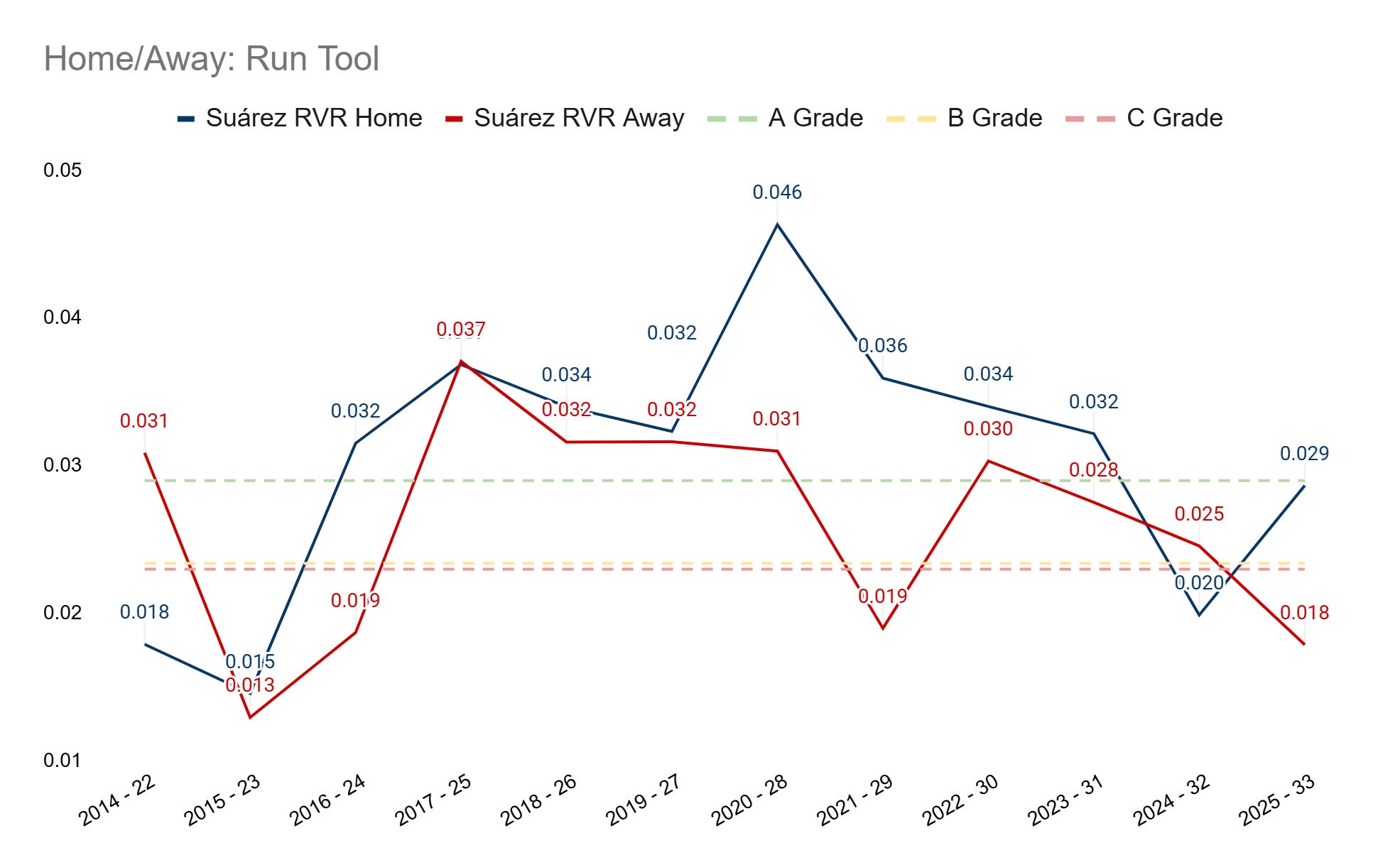
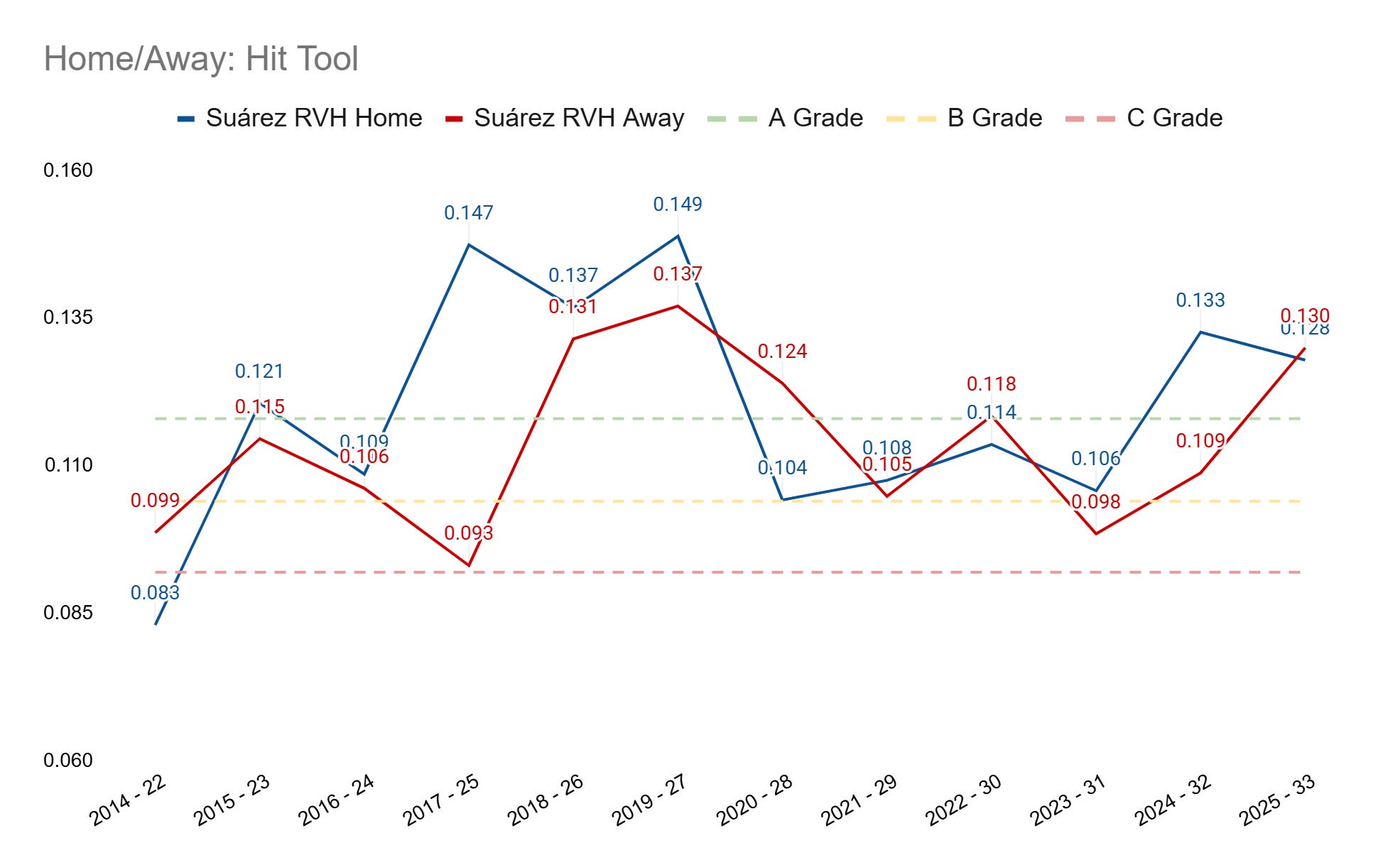
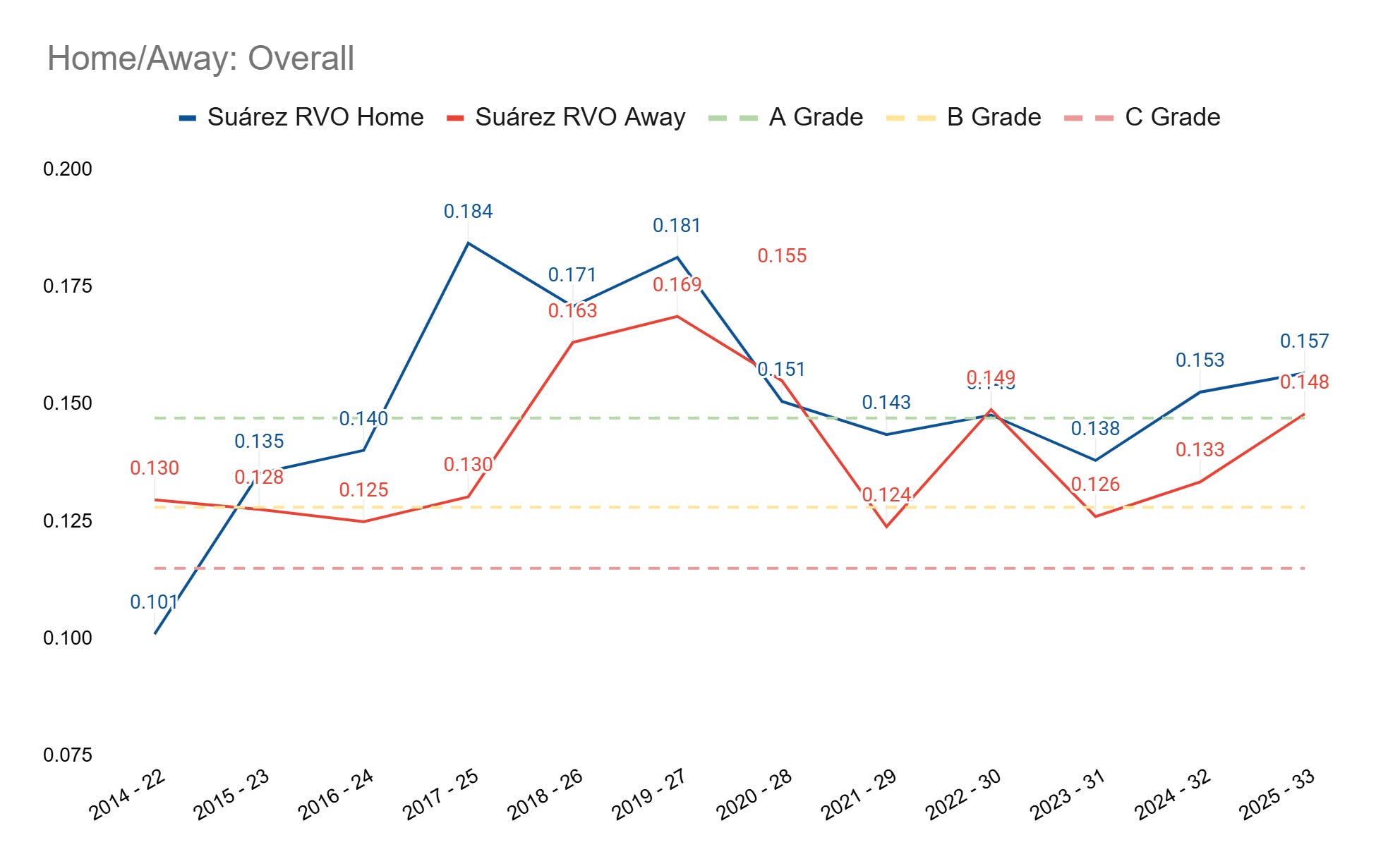
Home / Away - Still a wide lens, but splitting the totals by Home & Away. This provides a valuable look into possible larger trends at Home & Away. Not always the most informative, but interesting to look at. It was a factor in an evaluation I did last year for Jurickson Profar.
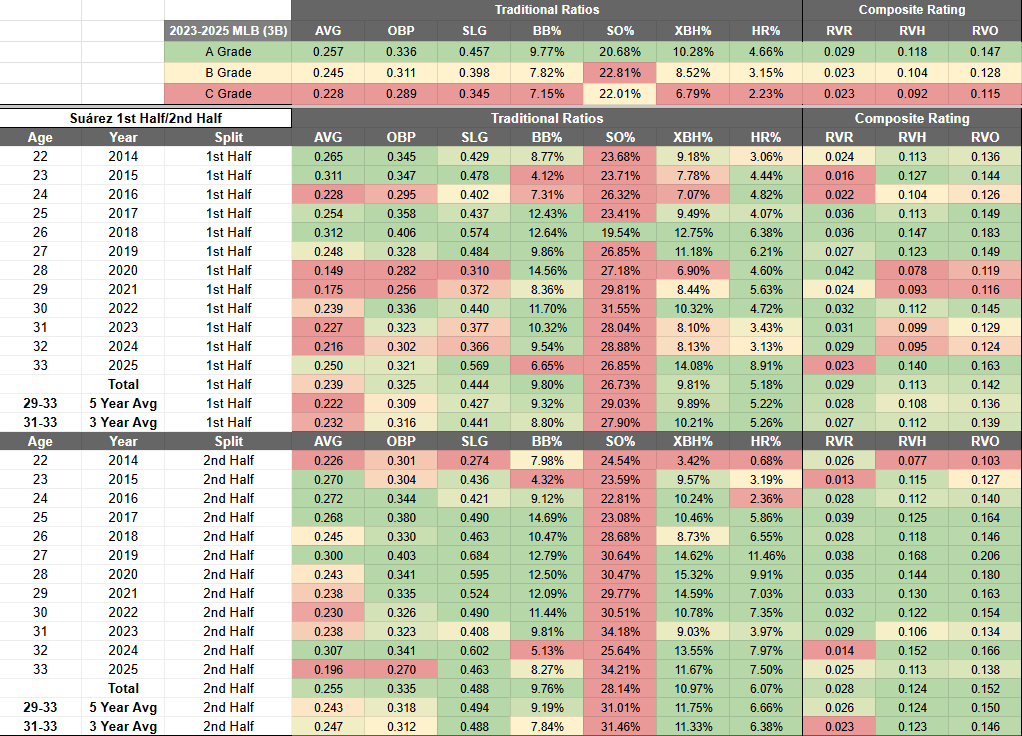
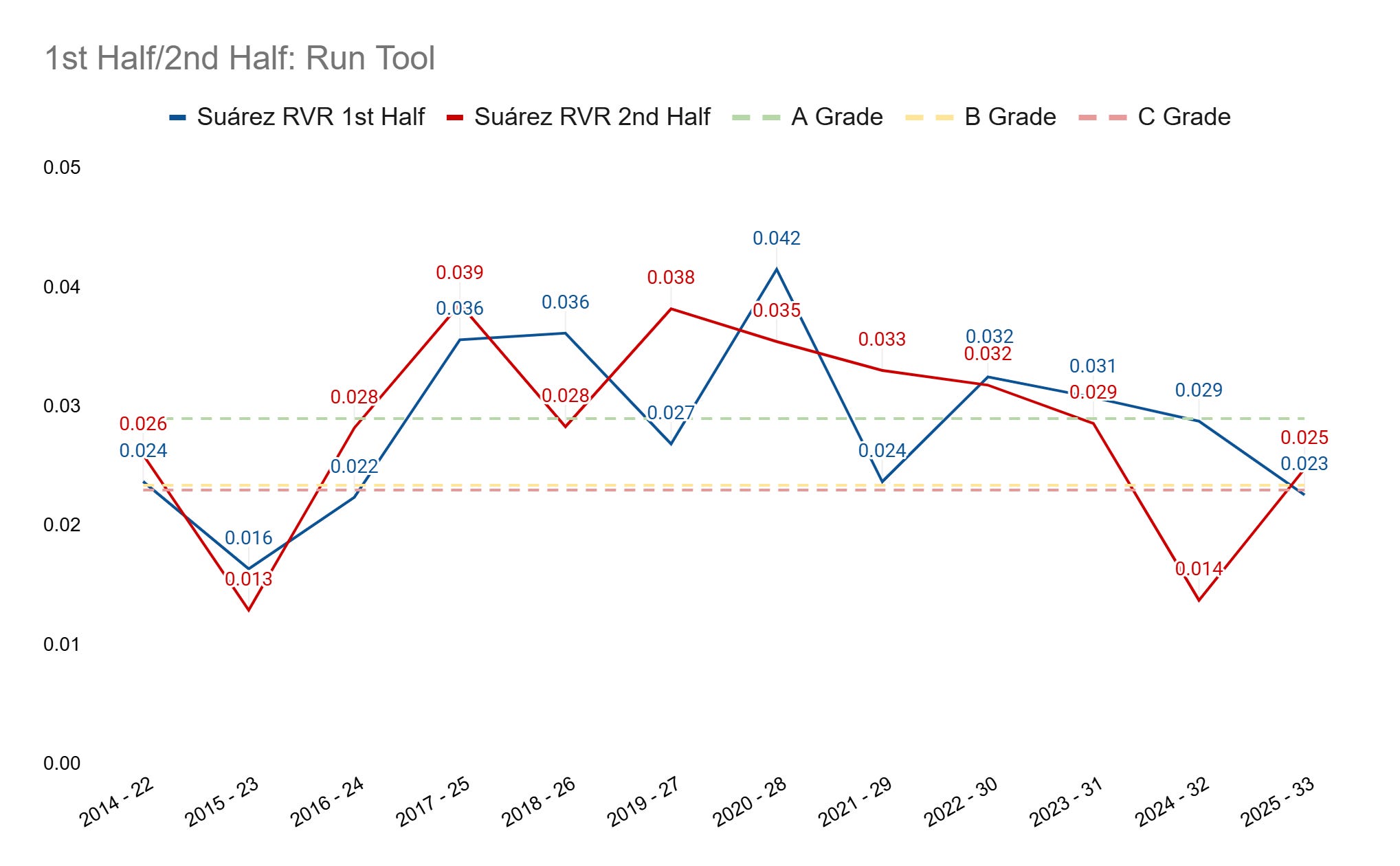
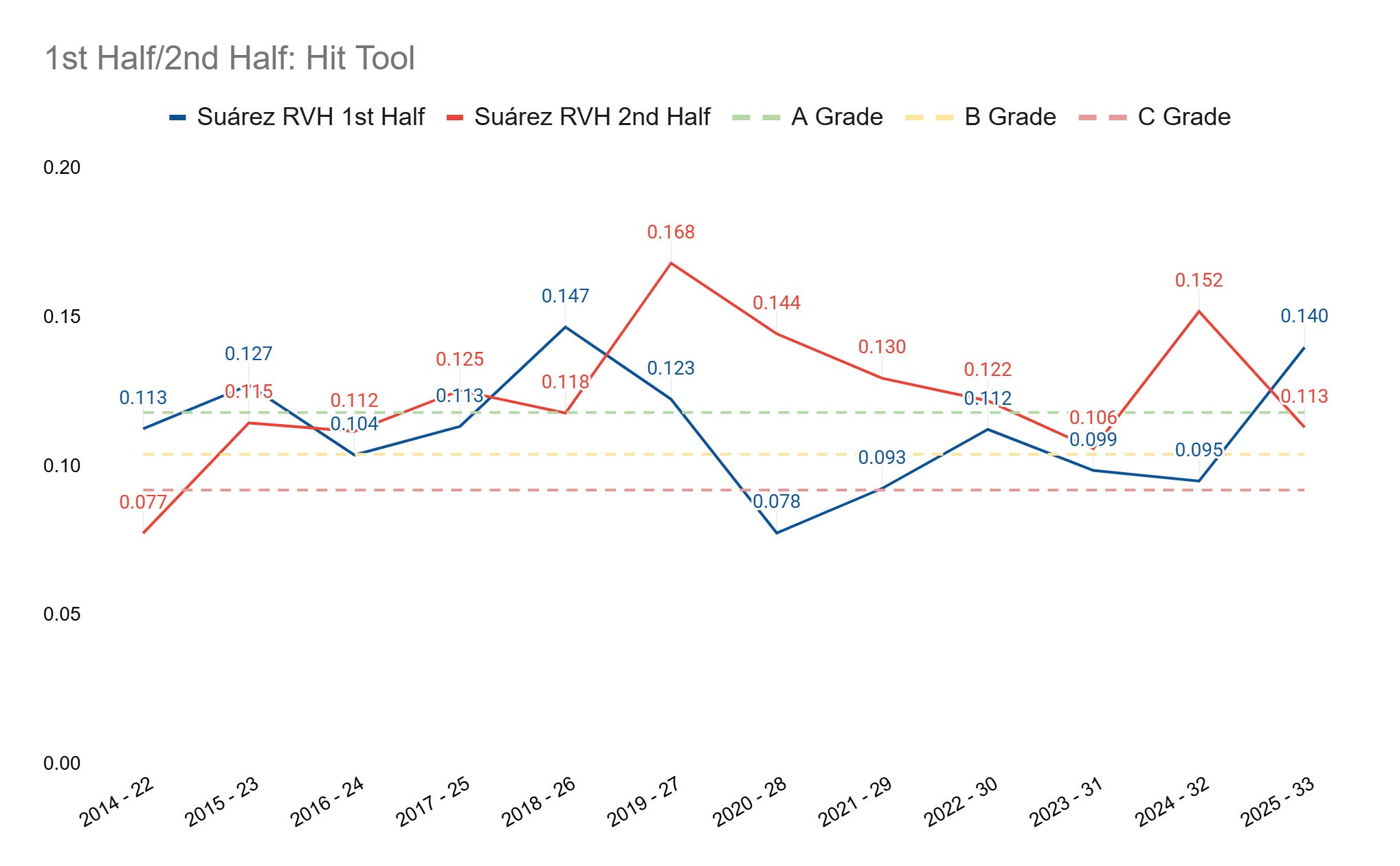
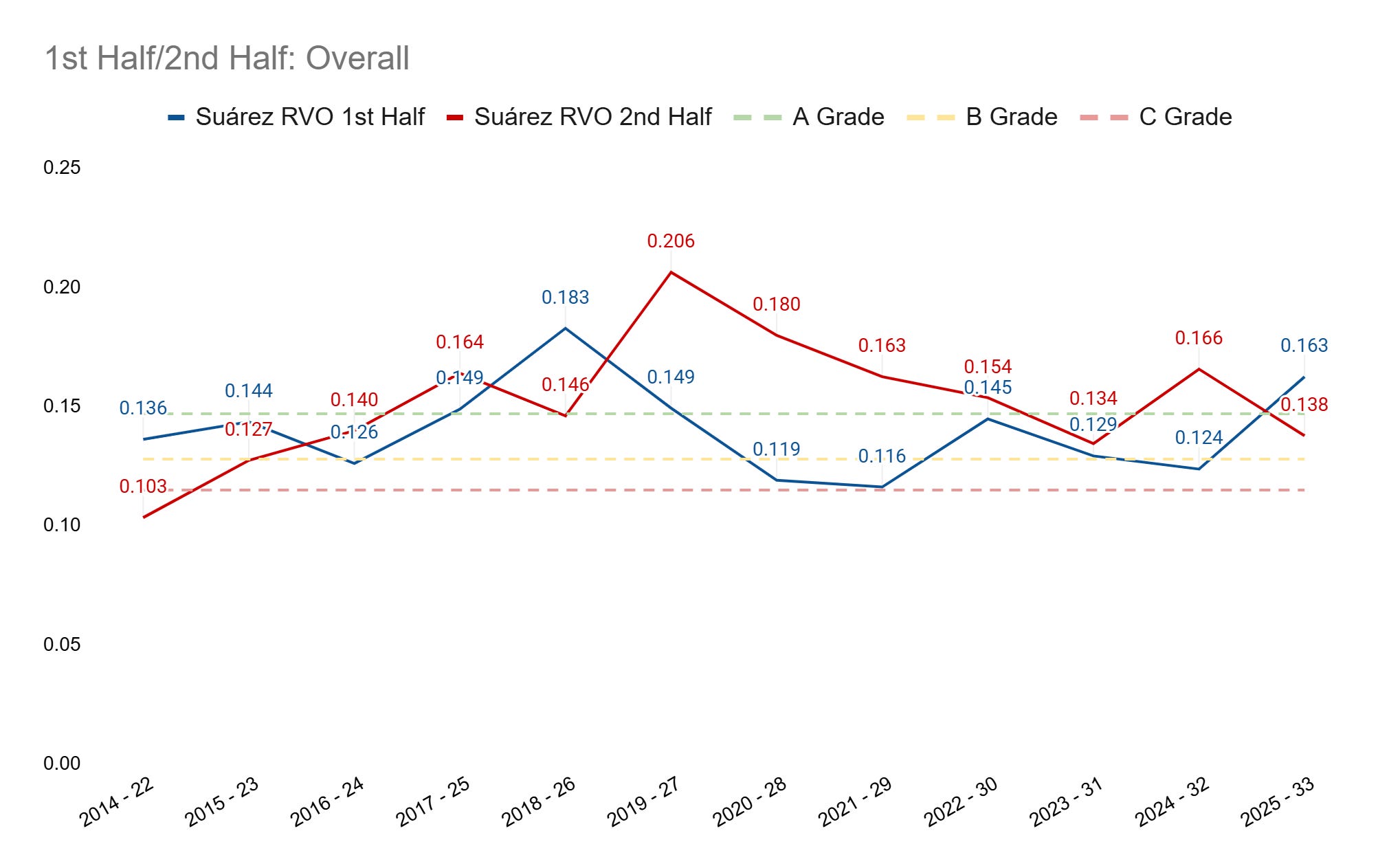
1st Half / 2nd Half - Still a widish lens, but splitting the totals by 1st & 2nd Half. This provides a valuable look into possible larger trends. Not always the most informative, but interesting to look at. 1st/2nd Half Splits were a factor in my Kyle Tucker’s 2026 Evaluation.
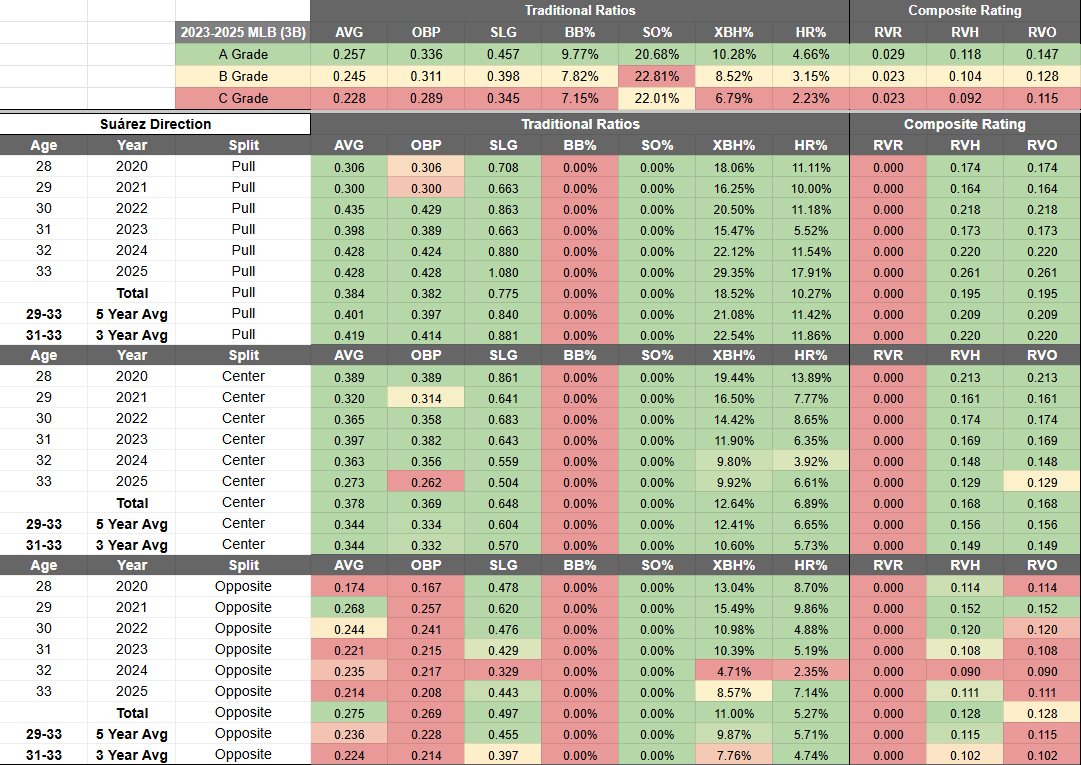
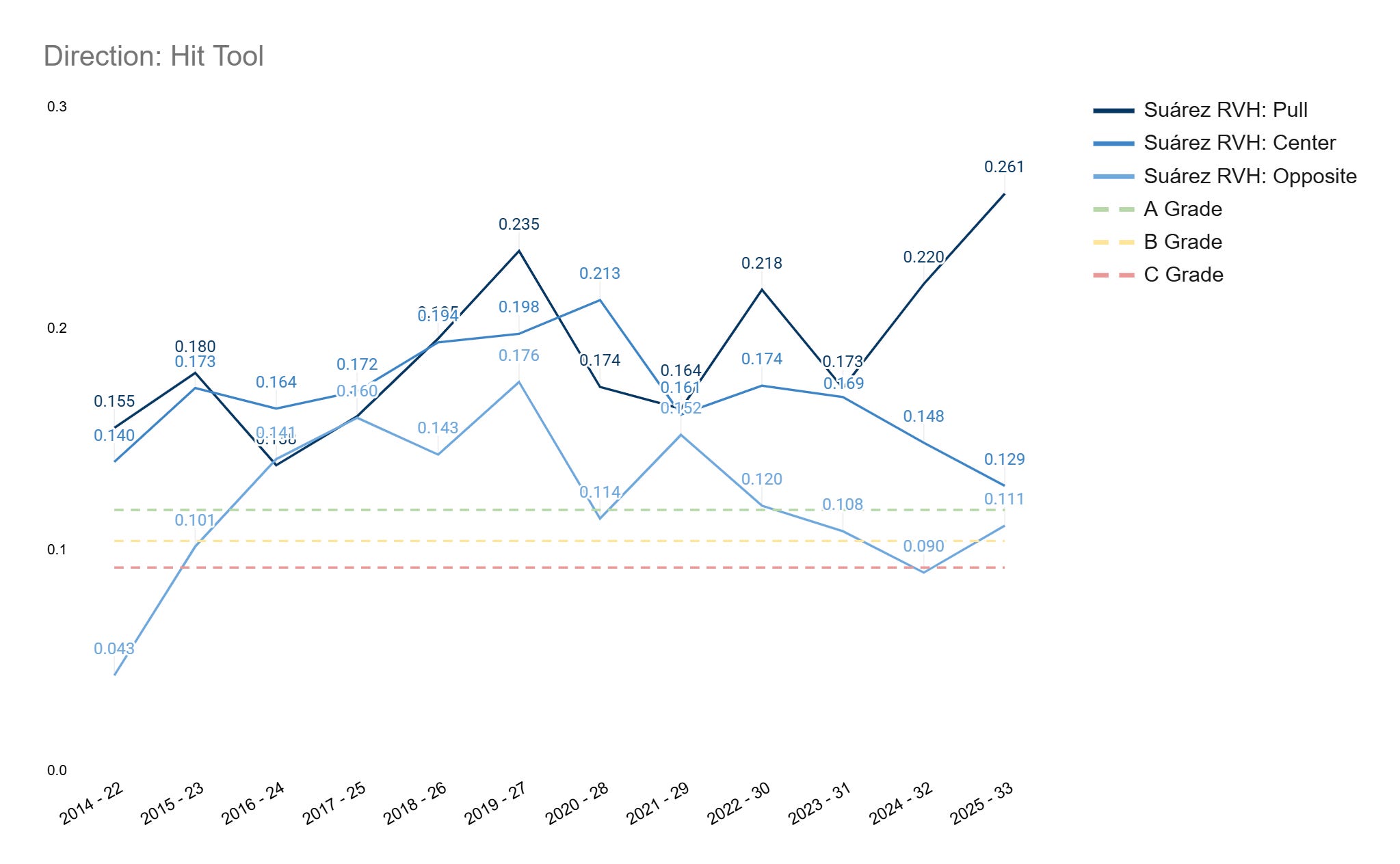
Direction:
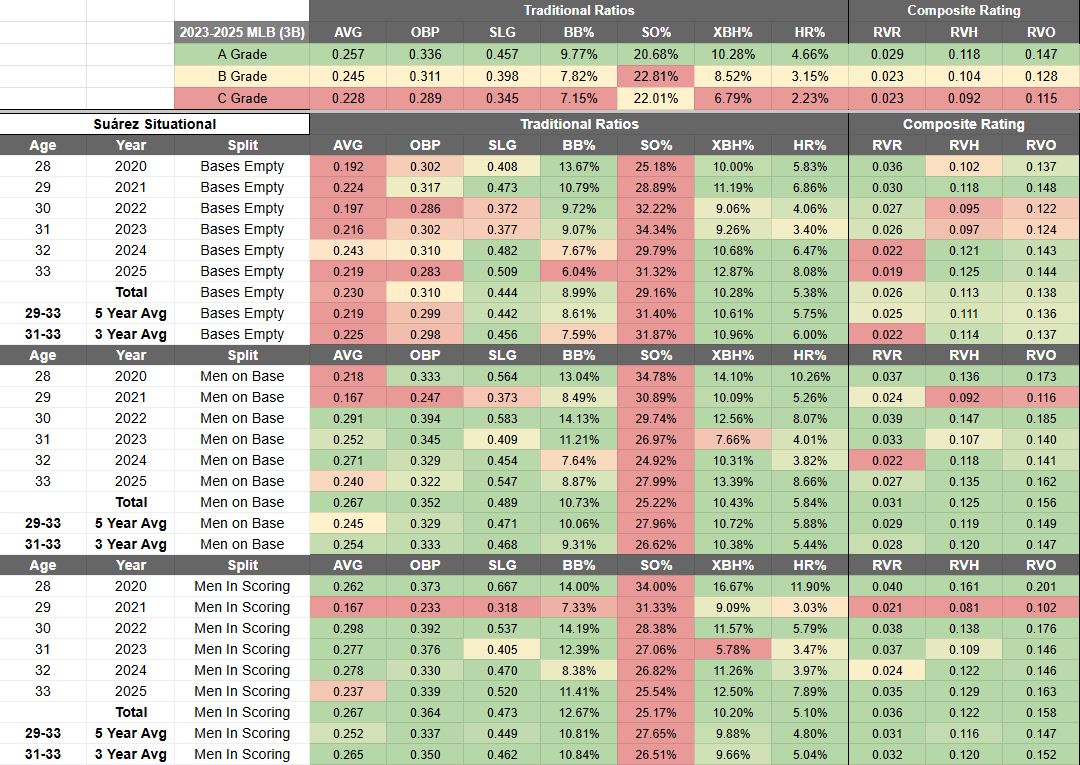
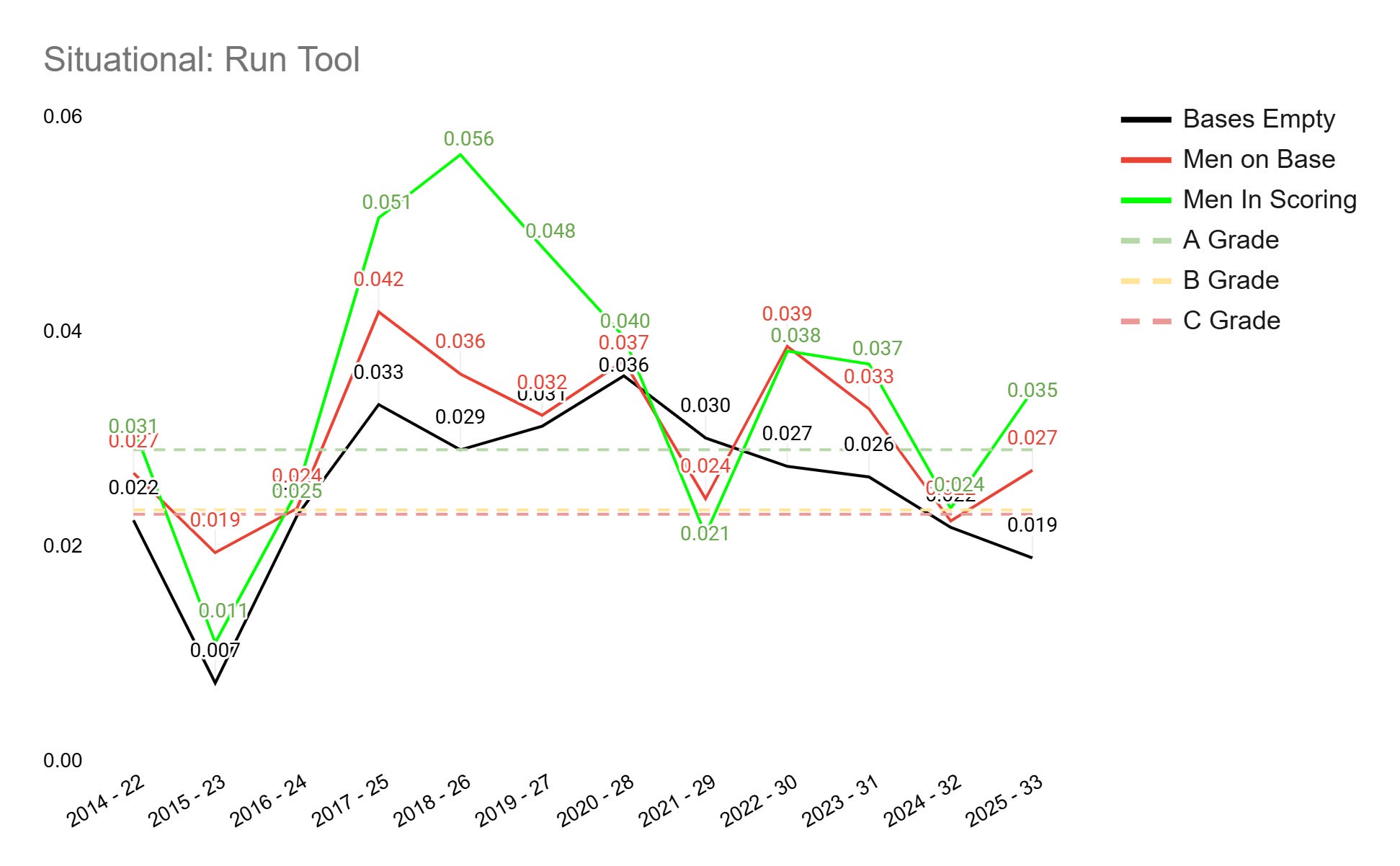
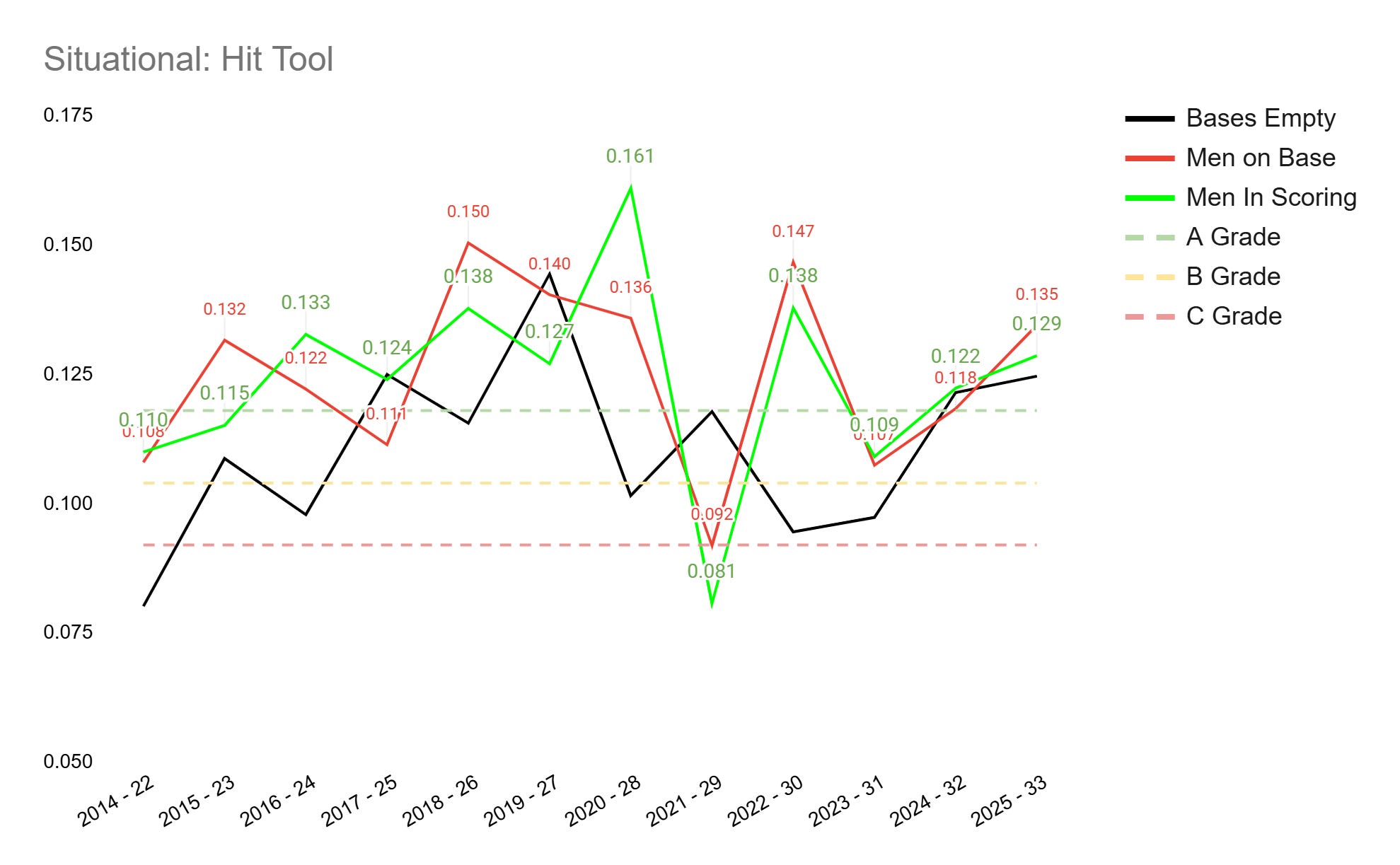
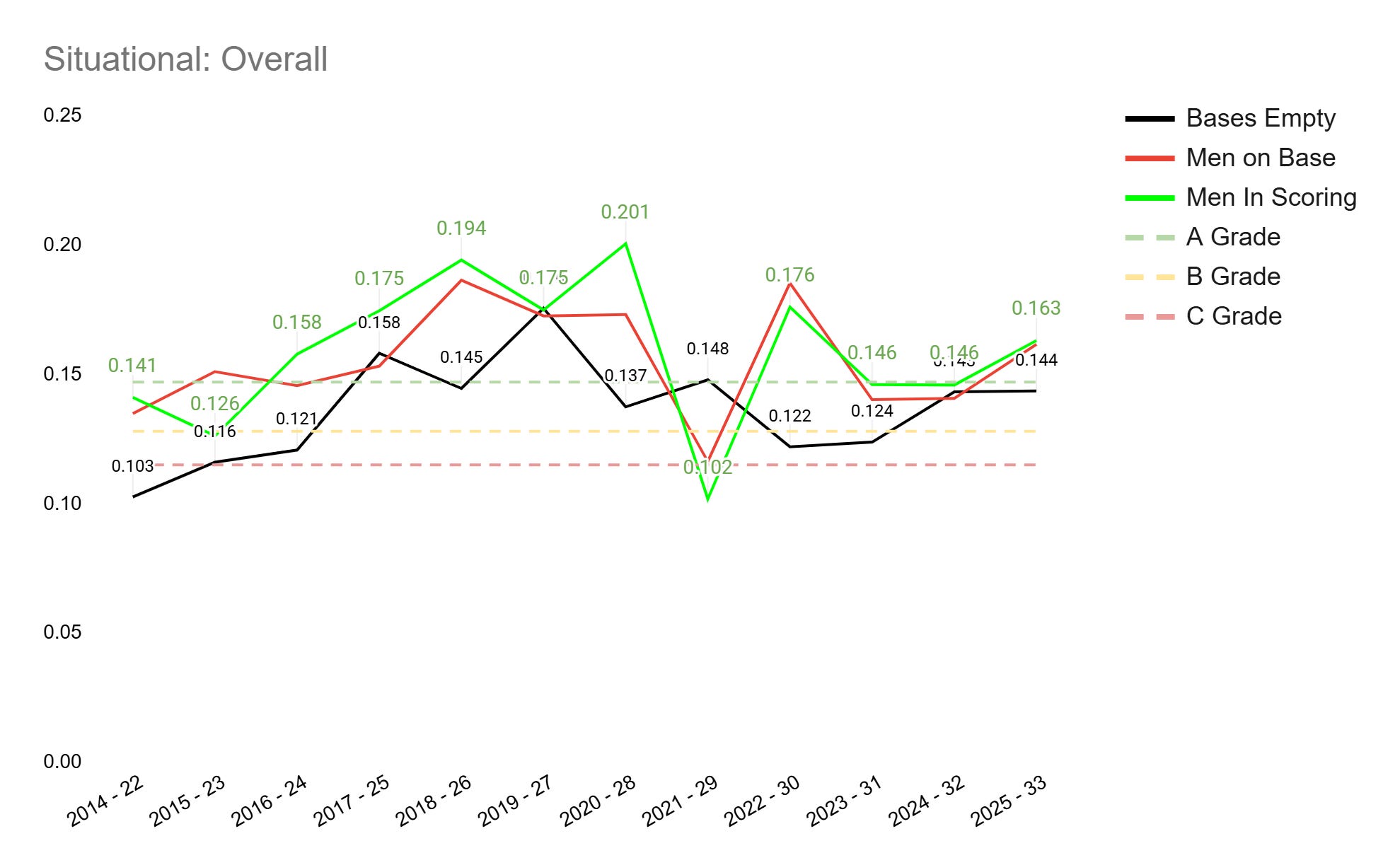
Situational - A still a wide lens, splitting totals into Bases Empty/ Men on Base/ Men in Scoring. This provides a valuable look into possible larger trends in particular situations. I believe Bases Empty/ Men on Base/ Men in Scoring are beneficial stats.
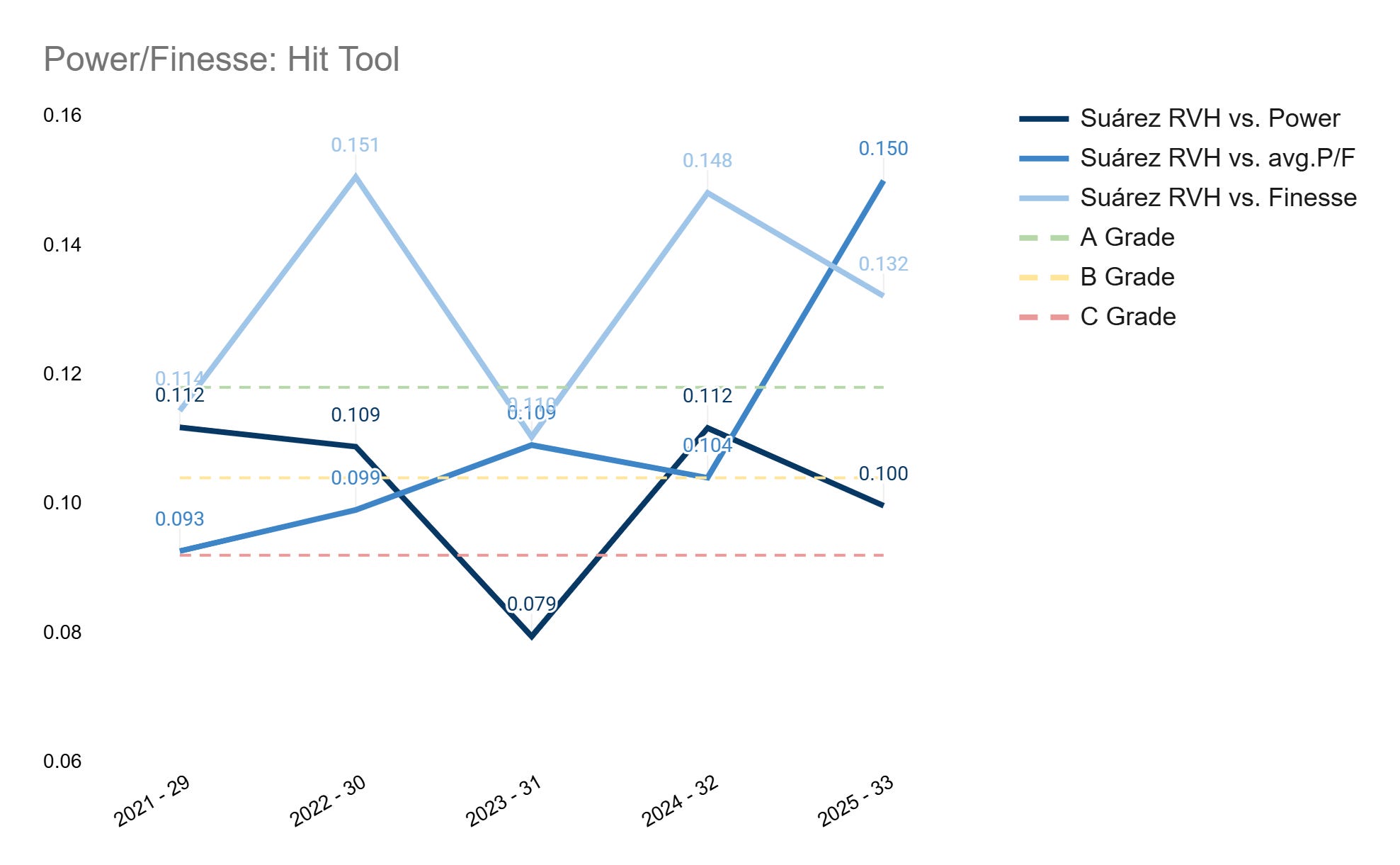
Power / Finesse - A wide lens, splitting totals against Power/avg/Finesse Pitching. I get this data set from Baseball Reference. Baseball Reference defines Power / Finesse as ‘Power pitchers are in the top third of the league in strikeouts plus walks. Finesse are in the bottom third of the league in strikeouts plus walks’. This provides a valuable look into possible larger trends against different types of pitchers. I am generally look at the Hit Tool here.
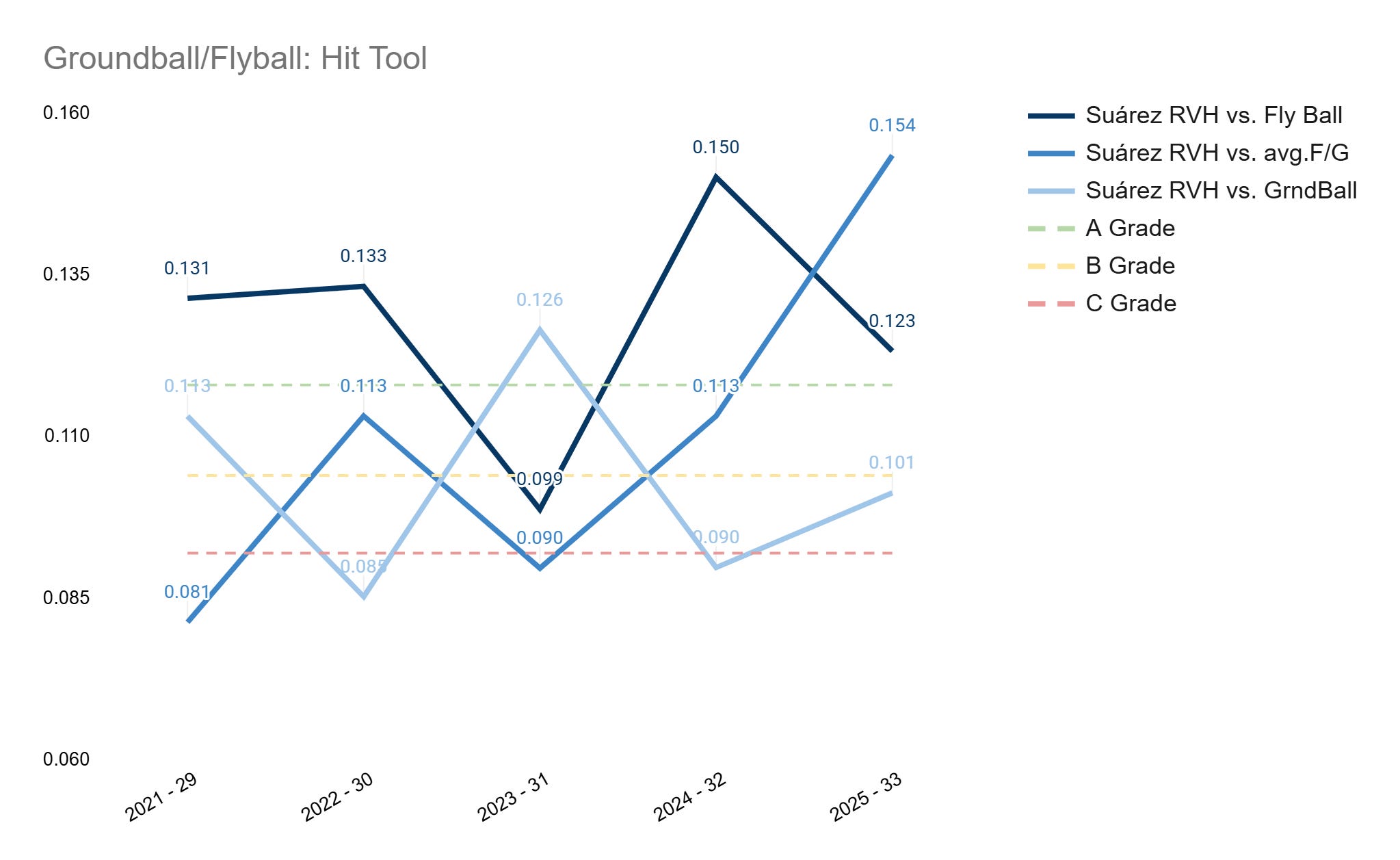
GB / FB - A wide lens, splitting totals vs. Ground Ball/Fly Ball Pitchers. I get this data set from Baseball Reference. Baseball Reference defines Ground Ball/Fly Ball as ‘Fly Ball pitchers are in the top third of the league in ratio of fly ball outs to ground ball outs. Ground Ball are in the bottom third of the league in the ratio of fly ball outs to ground ball outs’. This provides a valuable look into possible larger trends against different types of pitchers.
Pitch Mix
Playing Assistant GM
Eugenio Suárez will turn 35 in July, so this will likely be a 1 year deal, max 2 years. 2026 will be his 12th year in MLB and you do not survive 11+ years in MLB without the ability to make adjustments or understand what makes you successful. Regardless of performance, at 34 years old the check engine light automatically comes on to check the serpentine belt and look for rust on the chassis.
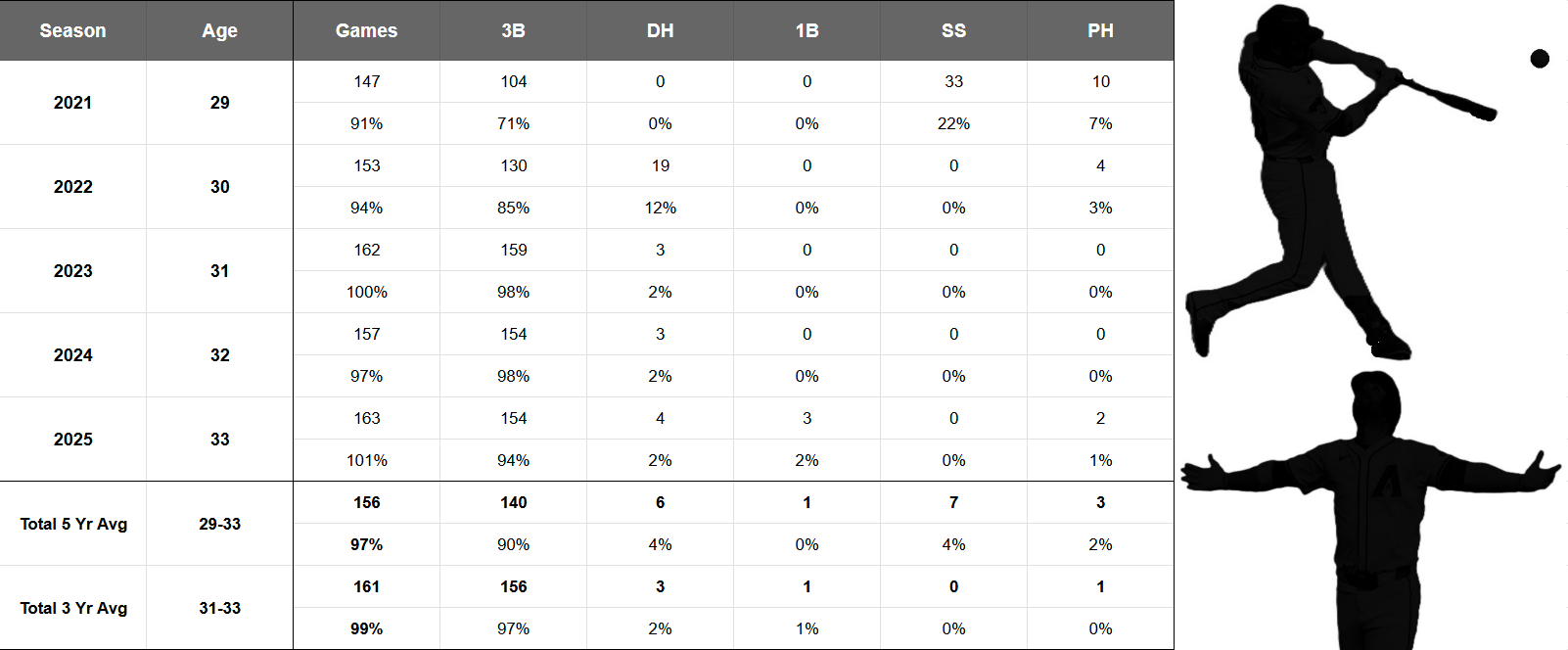
Suárez has a minimal injury history and posts everyday, over 97% games played the past 3 years. A large majority of those games coming at 3B. He’s been a reliable glove over at 3B until this past year where his fielding percentage fell below league average. His range took a bit of a dip as well. Years at 3B could be limited, but worth checking with R&D on positioning options/limitations. This could be a 3B/1B/DH play beyond 1 year.
The real question here can Suárez still produce at the plate?
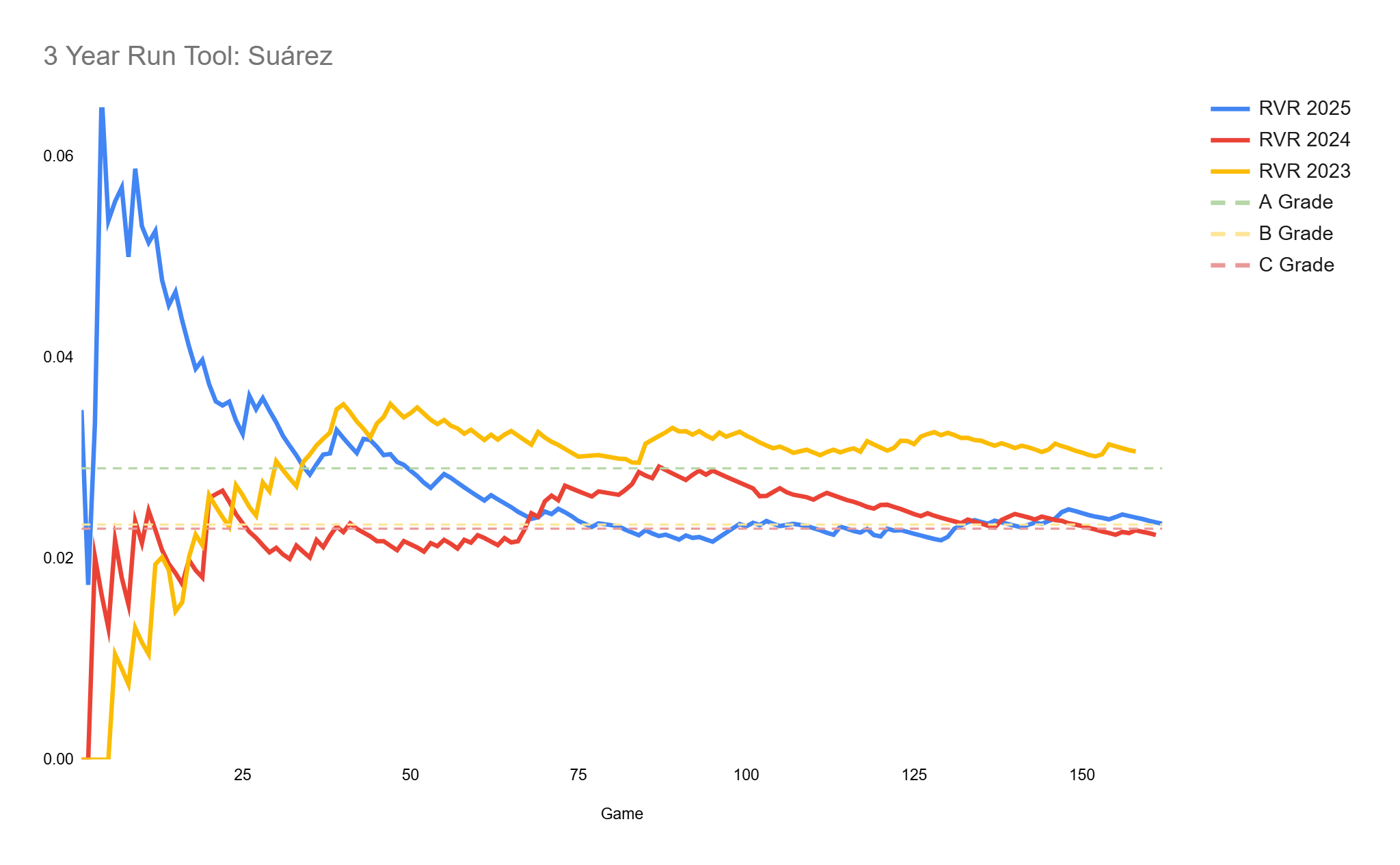
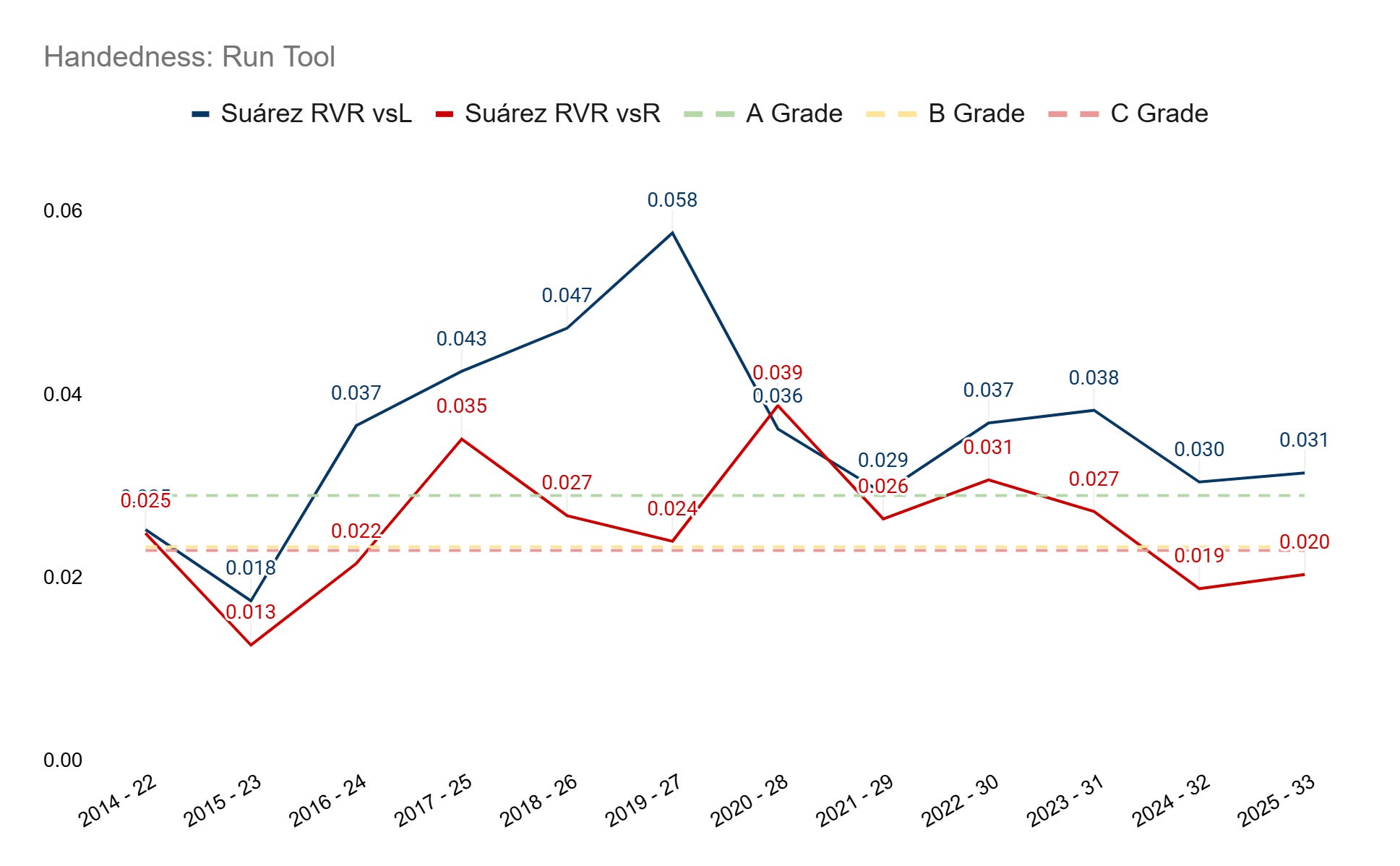
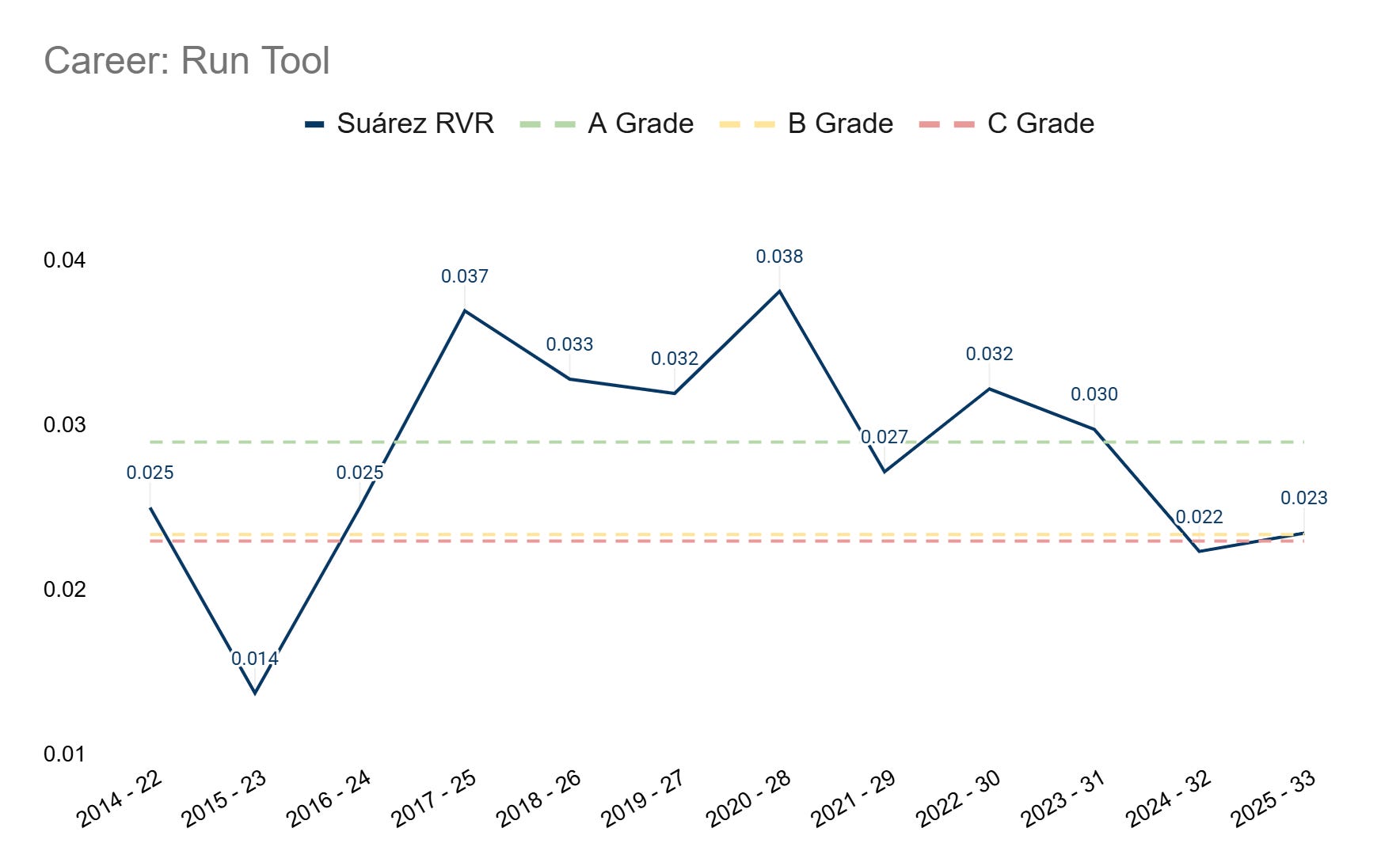
His Run Tool production has been slowly declining since a peak in 2020 at age 28, and is steading in the C Grade range. The primary Run Tool driver are his LHP & RHP Splits. If his Run Tool is not going to help sustain his production, I look to his Hit Tool …
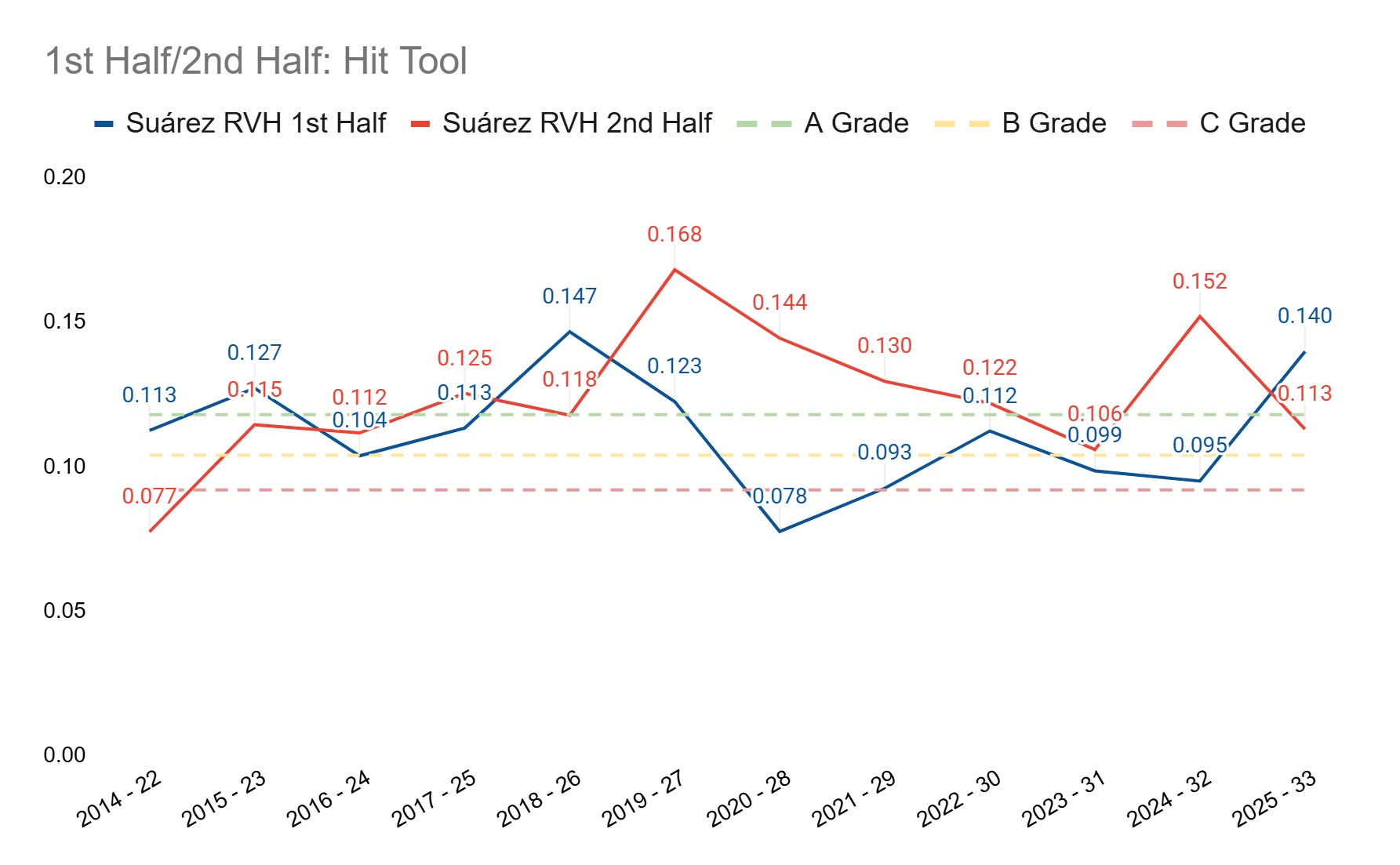
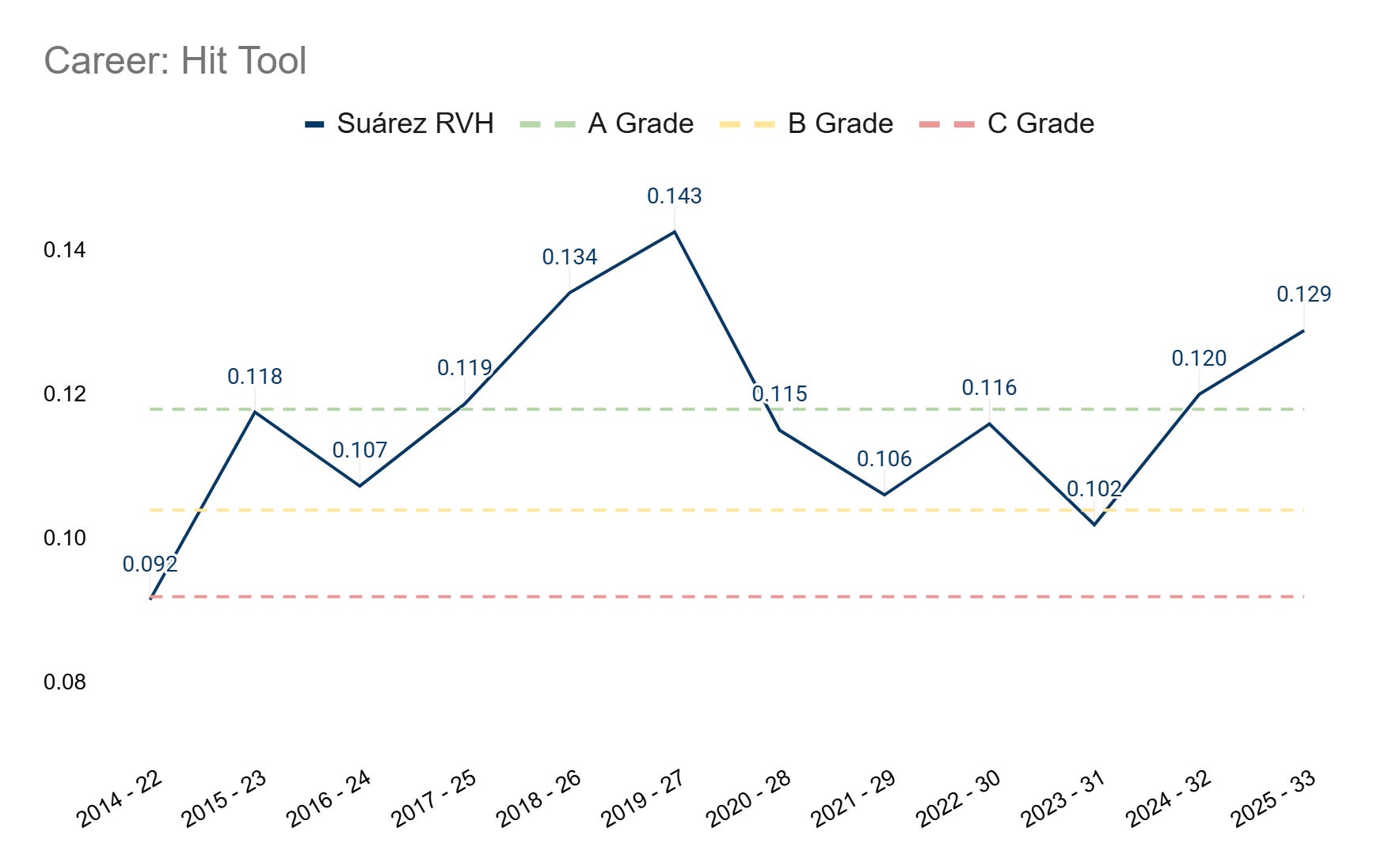
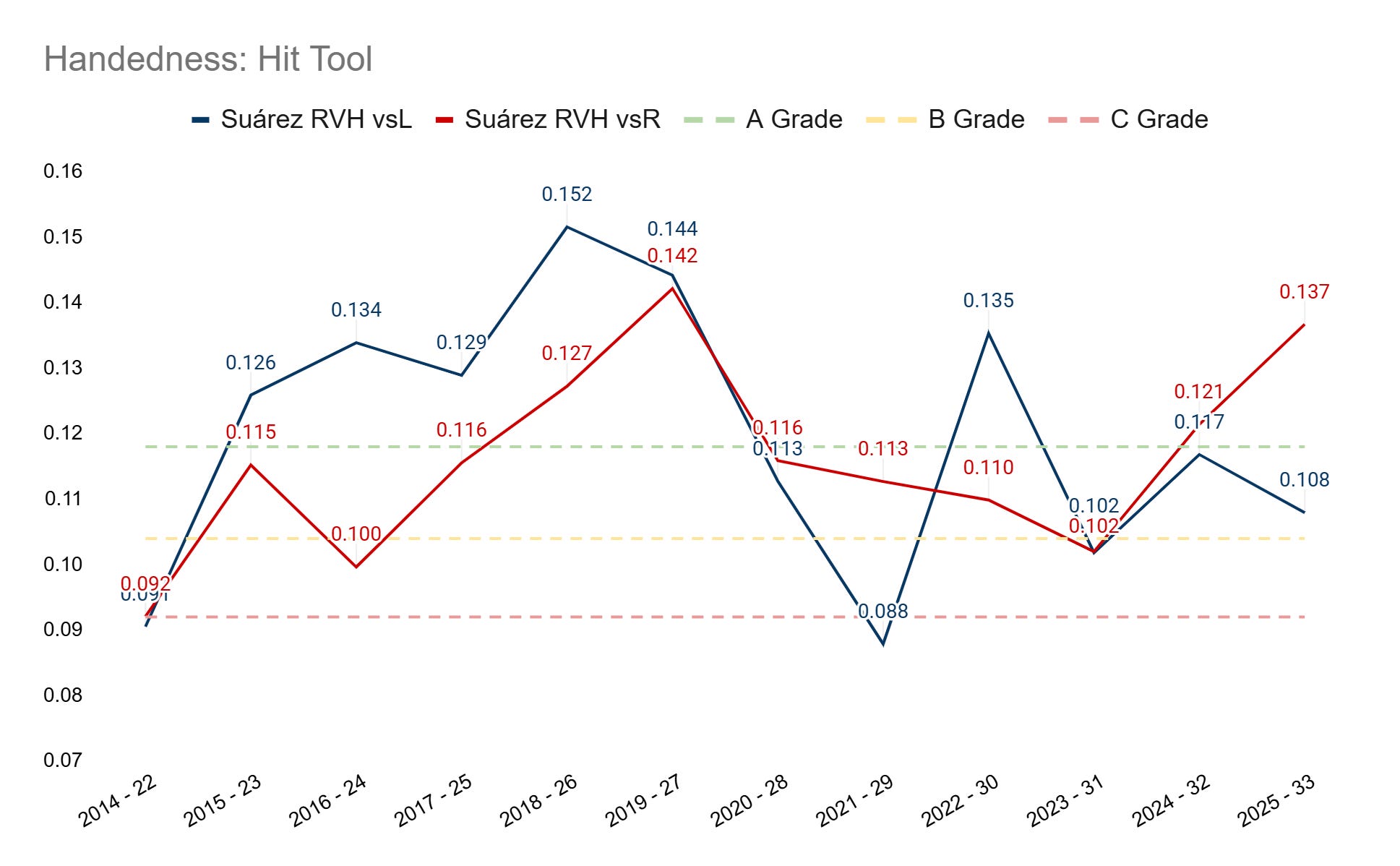
Suárez’s Hit Tool has been above B Grade to Elite-Elite through out his career. The five years from 2020 to 2024 Suárez’s 1st Half Hit Tool has been average to below average. Going into 2025, one of my biggest concerns would have been his slow starts in 2023 and 2024 are not trending too great. You have to think at some point the slow start may just become the player he will be. In 2025 Suárez bucked that trend pretty hard.
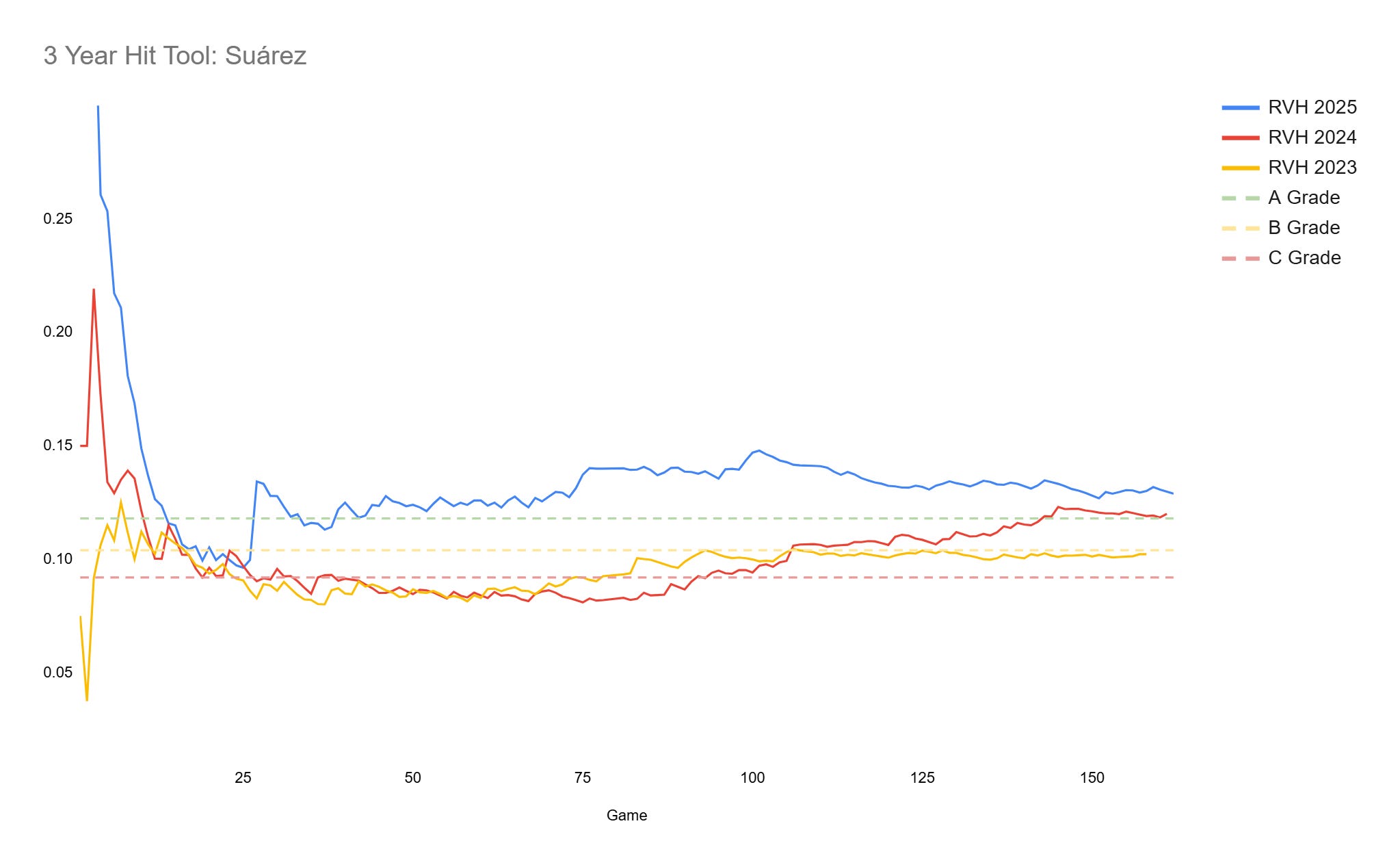
In 2025 Suárez’s Hit Tool was A Grade pretty much start to finish. There was a bit of a fall off with the Hit Tool in the 2nd Half in 2025, but it’s tough to tell how much of that had to do with playing in Seattle. It’s not a great place to hit between the angle/light of the batter’s eye.
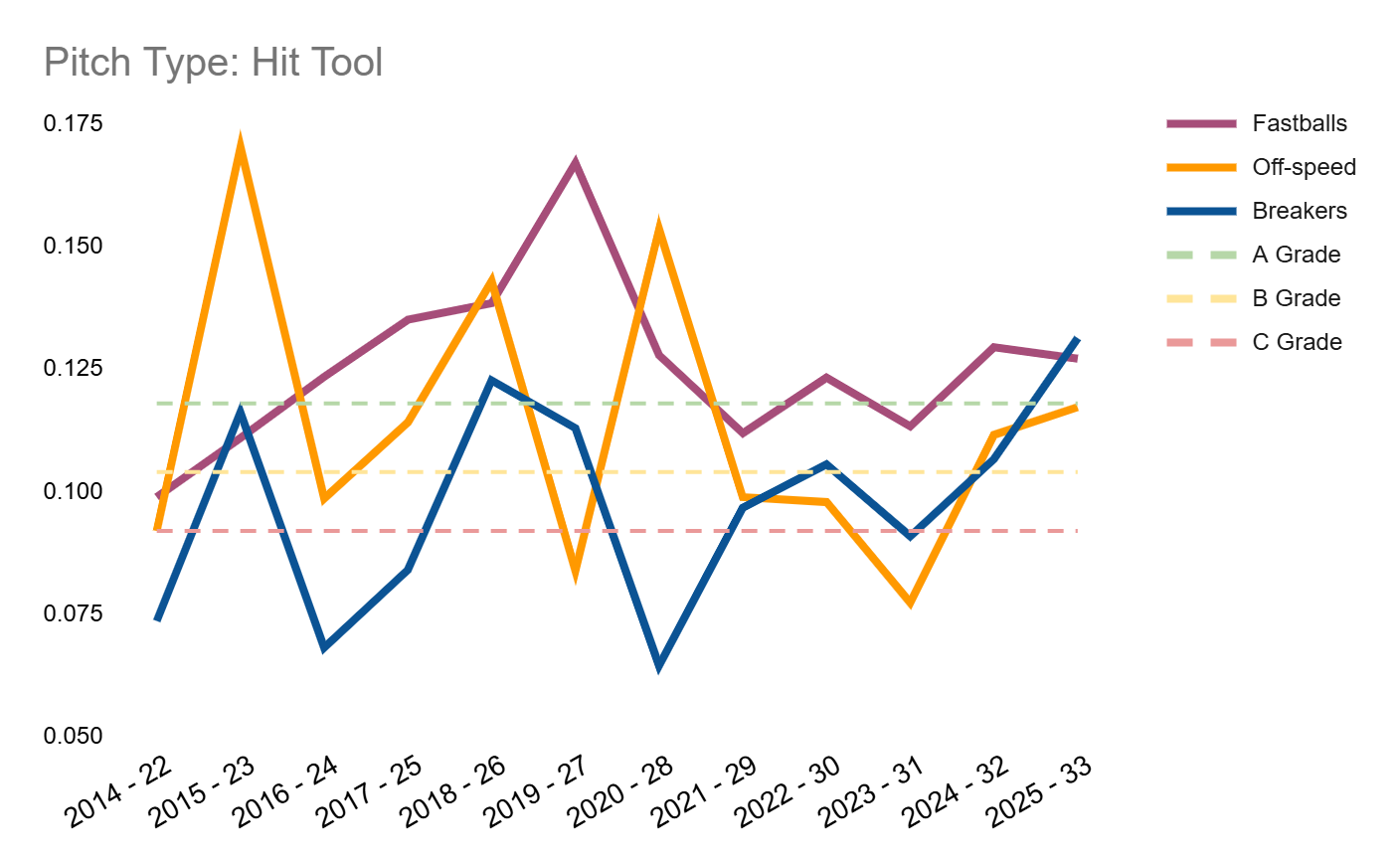
A lot of his rate in 2025 came from his production off RHP. Over his career he’s generally been a B-Grade or better both LHP & RHP. To dive deeper into the Hit Tool a lot of the underlying metrics hold up well, as well. The best example of this has been his production against various pitch types throughout his career. Typically one of the first things to go in older player is their ability to hit off the fastball.
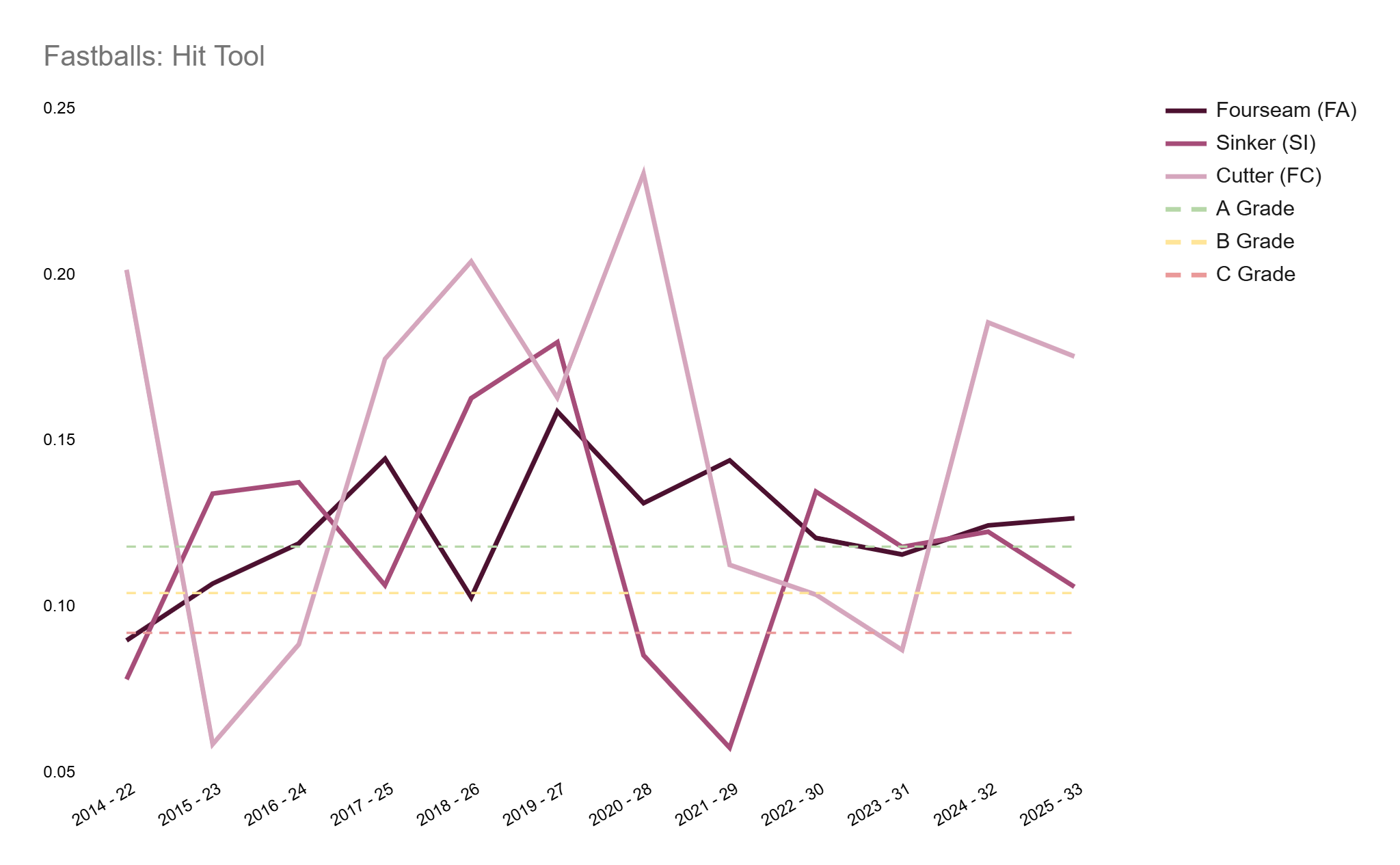
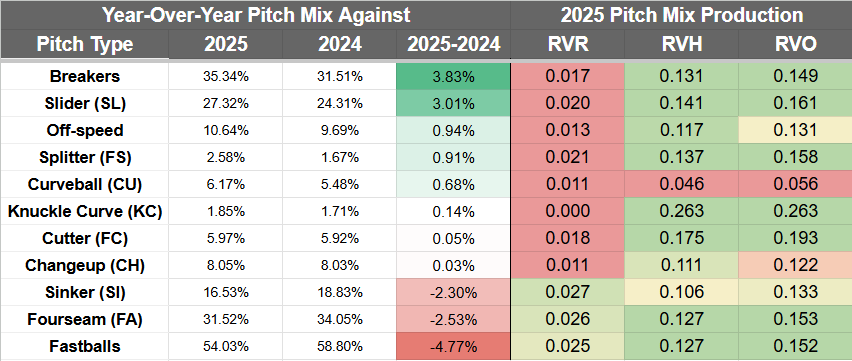
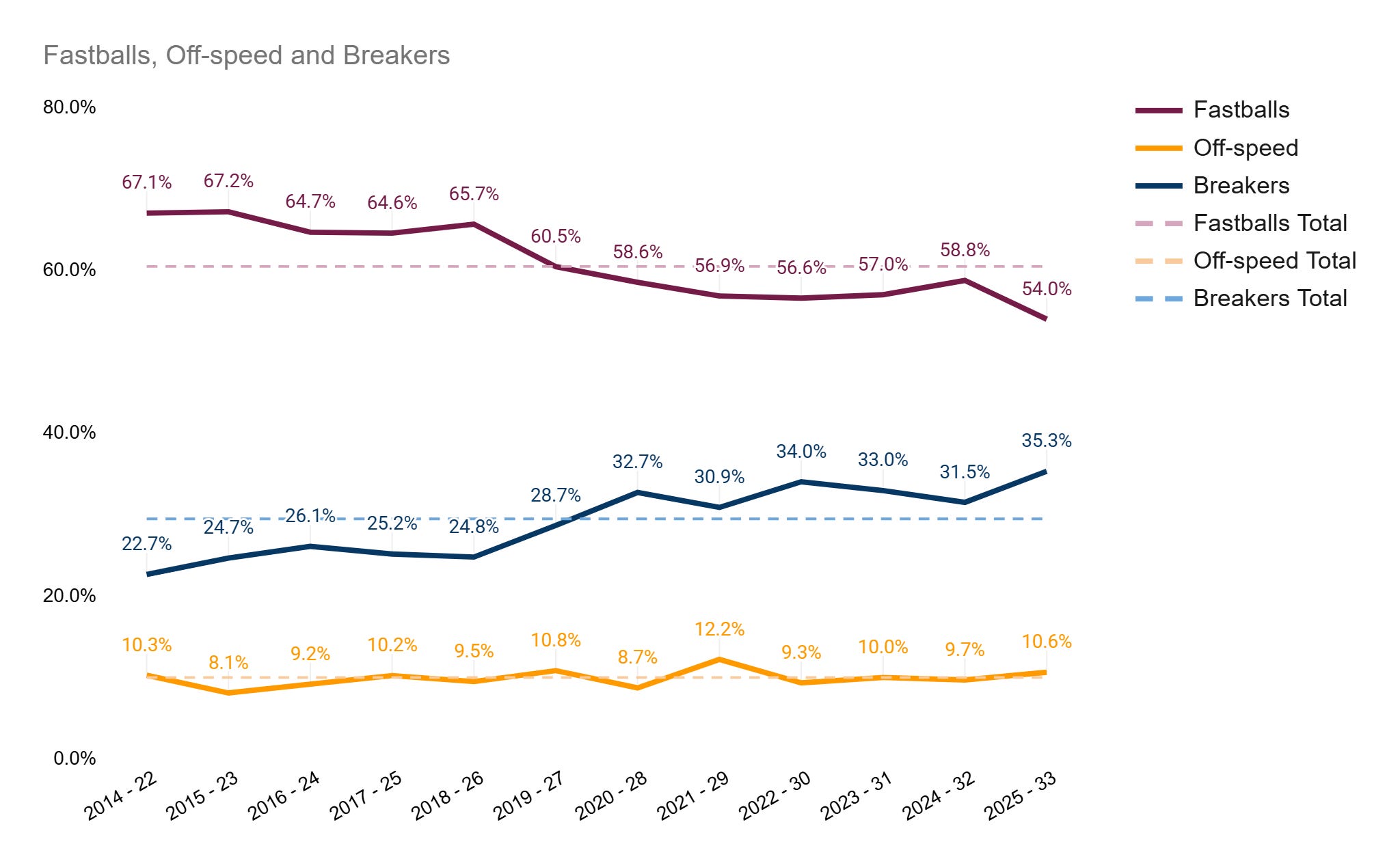
Suárez is in large part A Grade across the board against the fastball. Very rarely do you see Suárez have more than 1 or 2 down years in the same area. You can see his progressions, thinking one year ahead. When I saw his production against fastballs I was curious to see how pitchers were trying to get him out. So I reviewed the Pitch Mix…
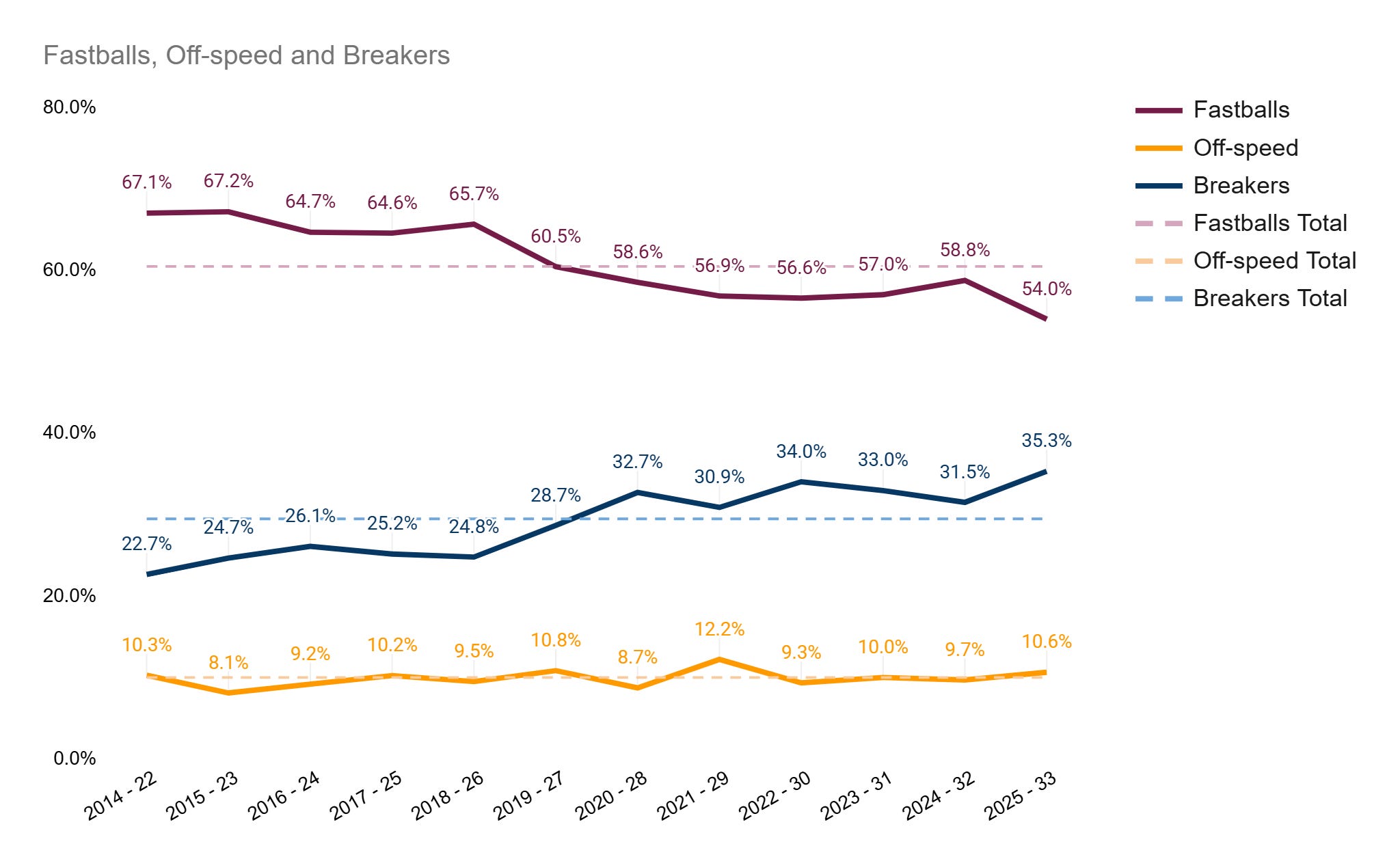
To no surprise pitchers are/have been reducing their Fastball usage against Suárez. The uptick in breakers forced me to analyze if there was a massive drop in production…
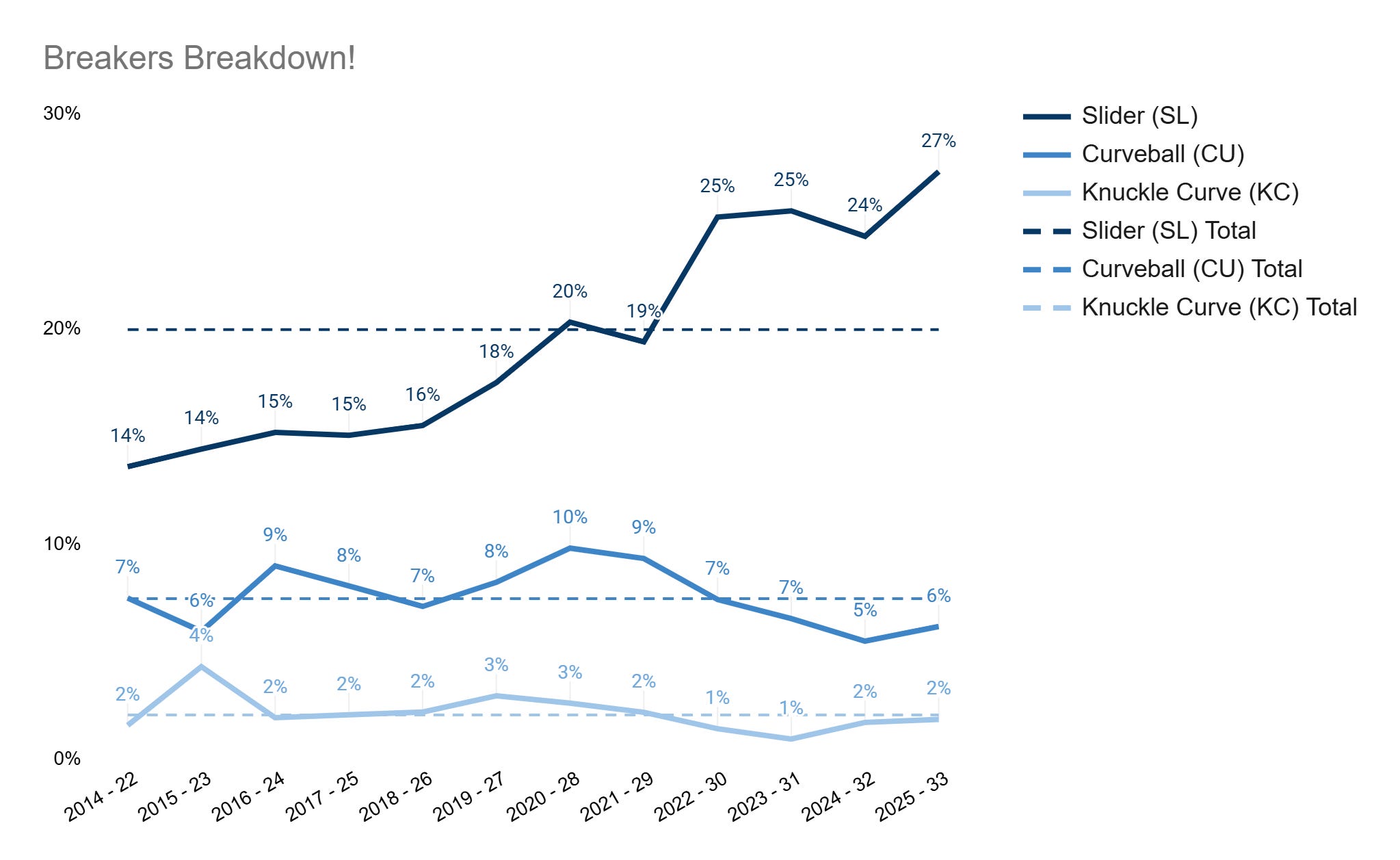
The uptick in Breakers is specifically coming from Sliders going back to 2020.
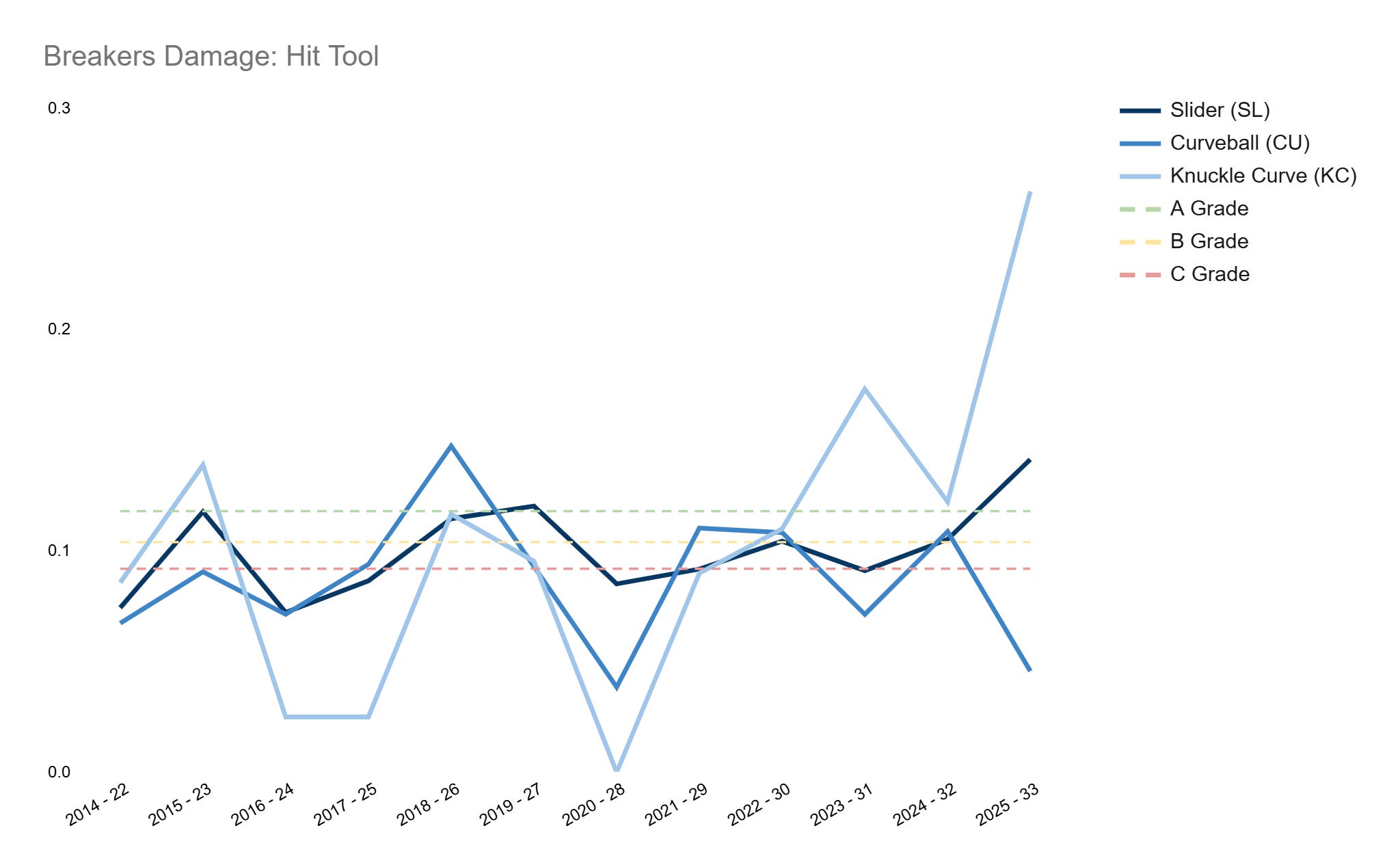
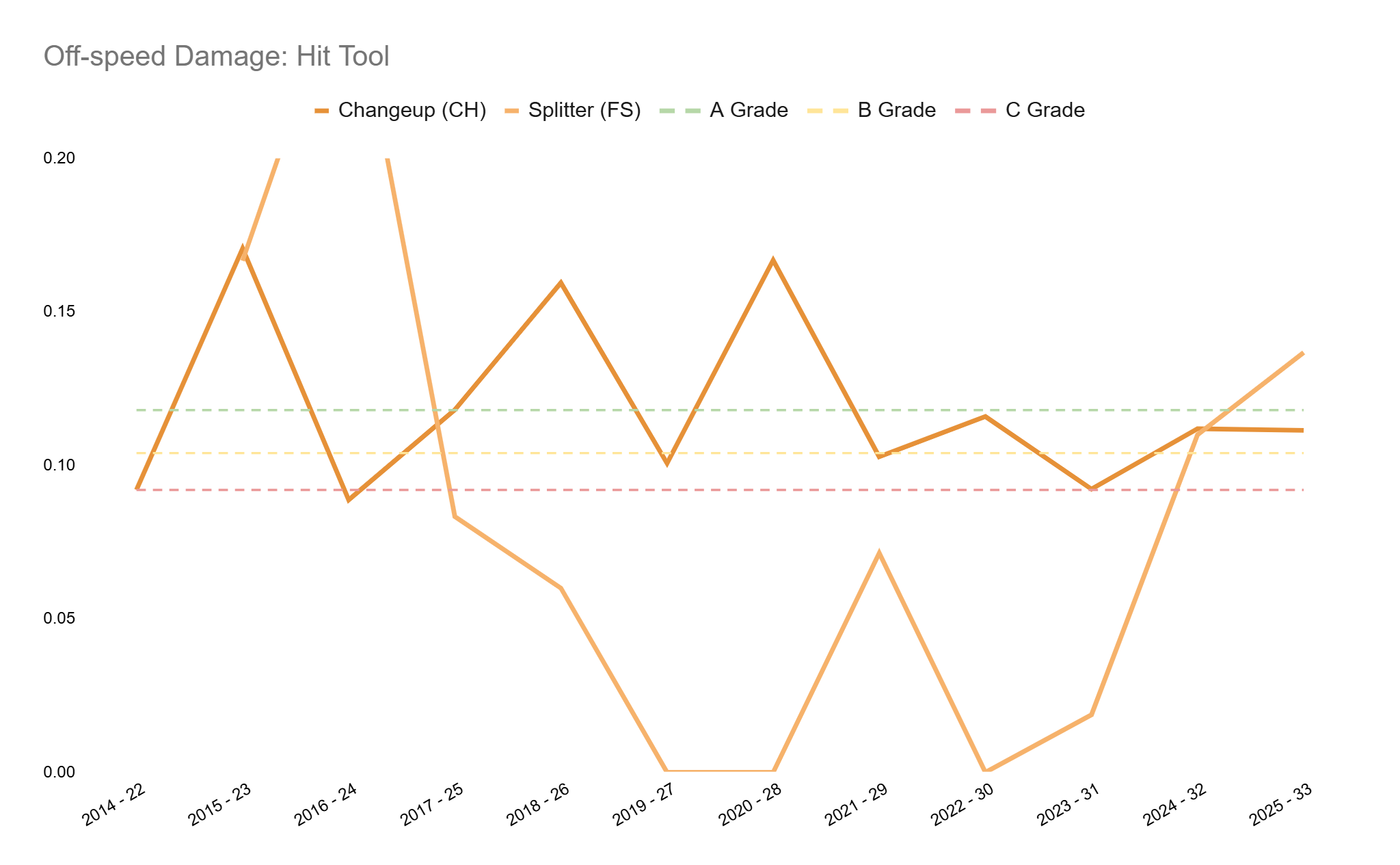
From 2020-2024 his Hit Tool against Sliders has been B-C Grade. I think this usage trend will shift away from sliders in 2026 (possibly to curveballs), because in 2025 Suárez Hit Tool was Elite against Sliders. Another sign of Suárez’s ability to make adjustments, being a professional. Moving forward, the pitch of 2025 was the splitter, and that won’t be an issue for Suárez, great production.
Lastly, I looked at Bat Speed and direction of production.
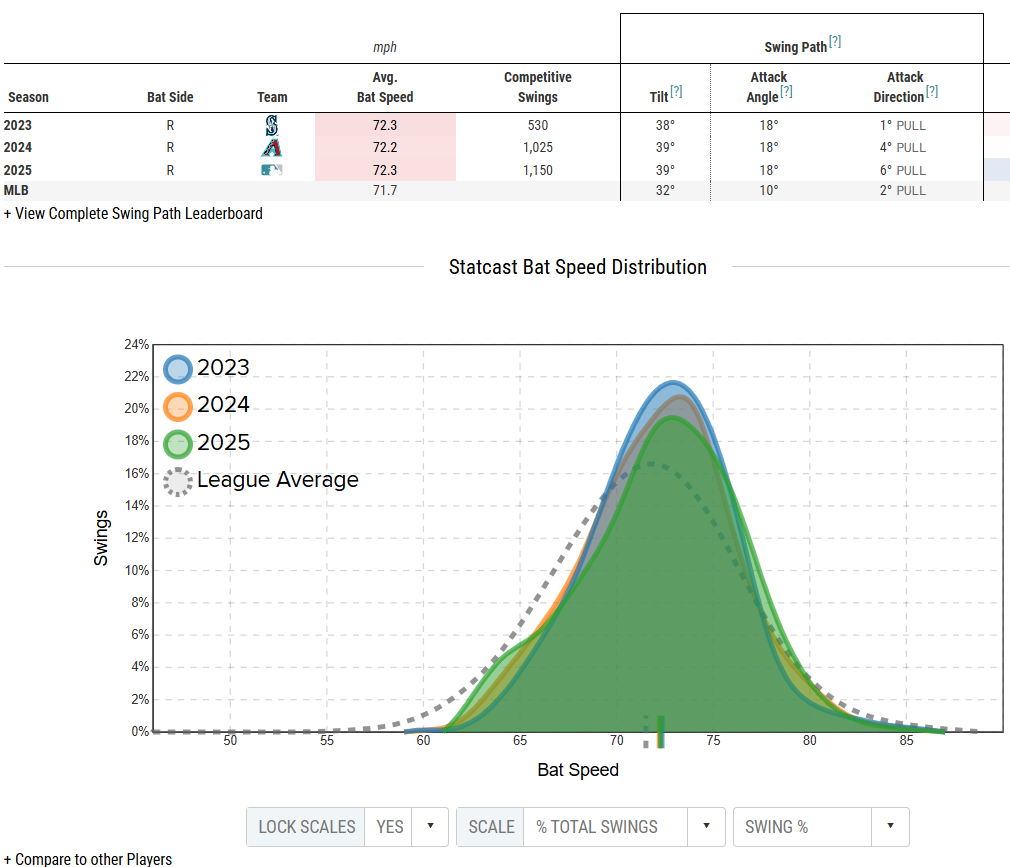
In terms of Bat Speed - no significant changes here. As for Direction of balls hit he is still able to pull the baseball with authority. His production to the middle of the field has been declining, but still A-B Grade. Straight Away and Opposite field trending similarly.
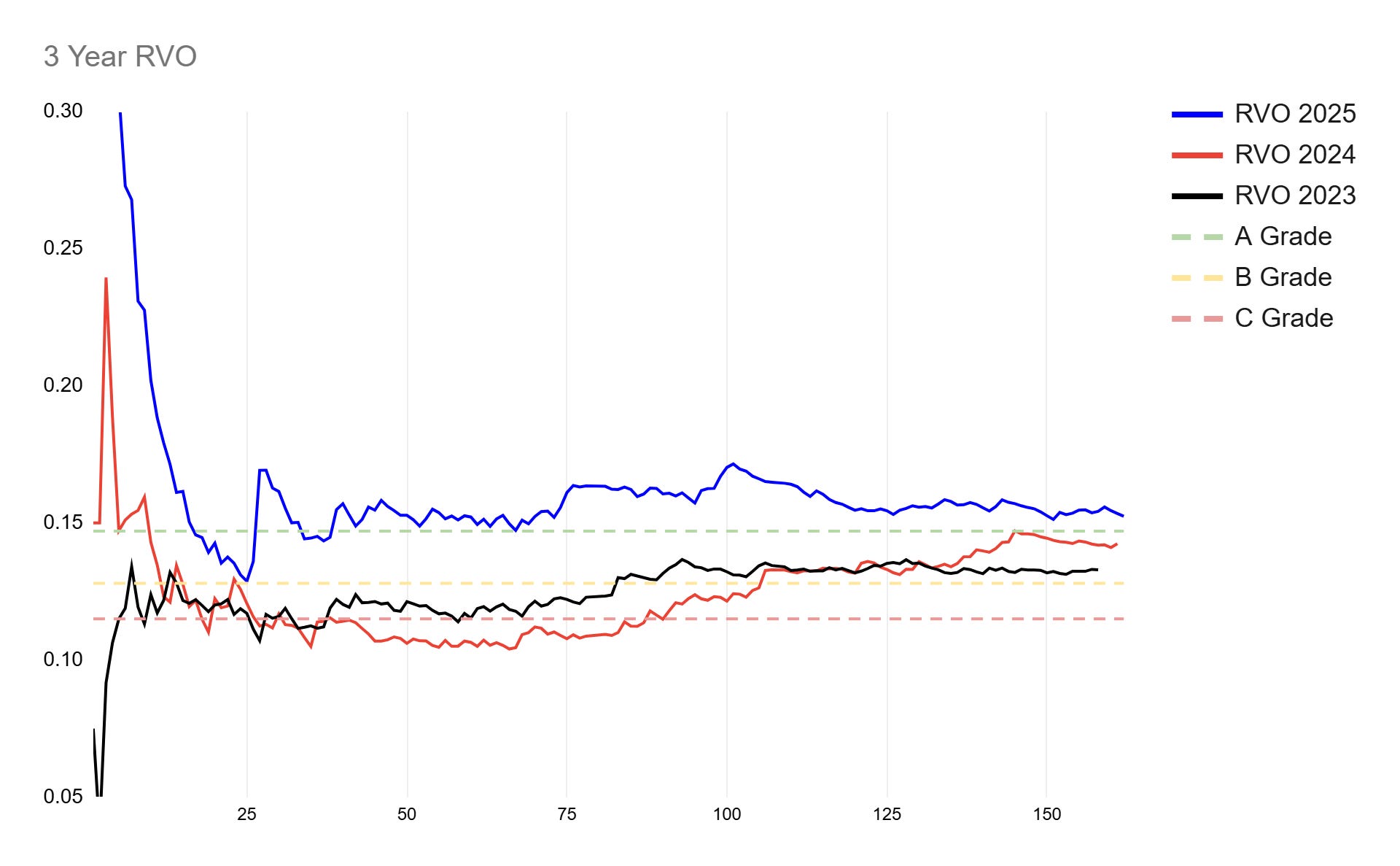
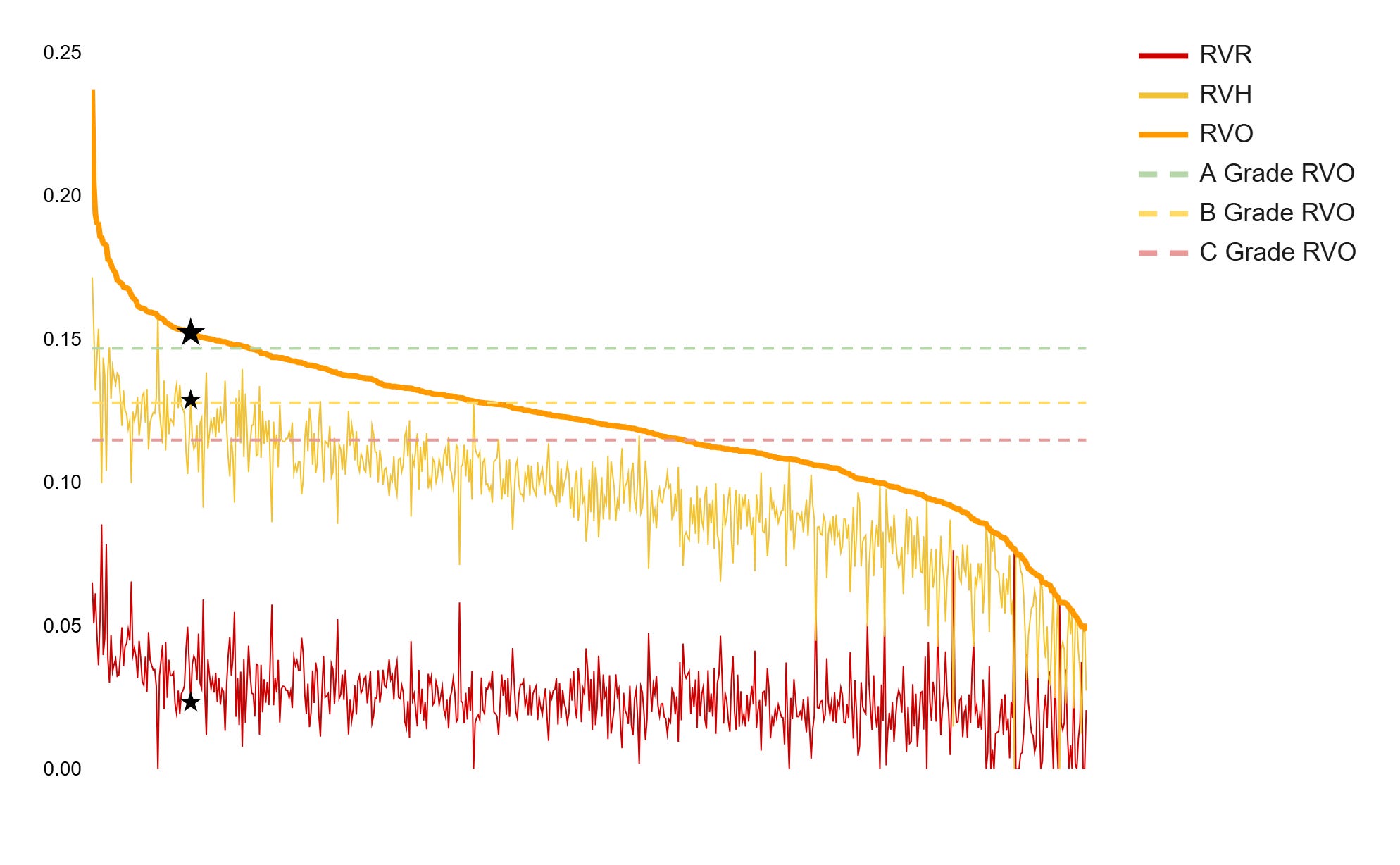
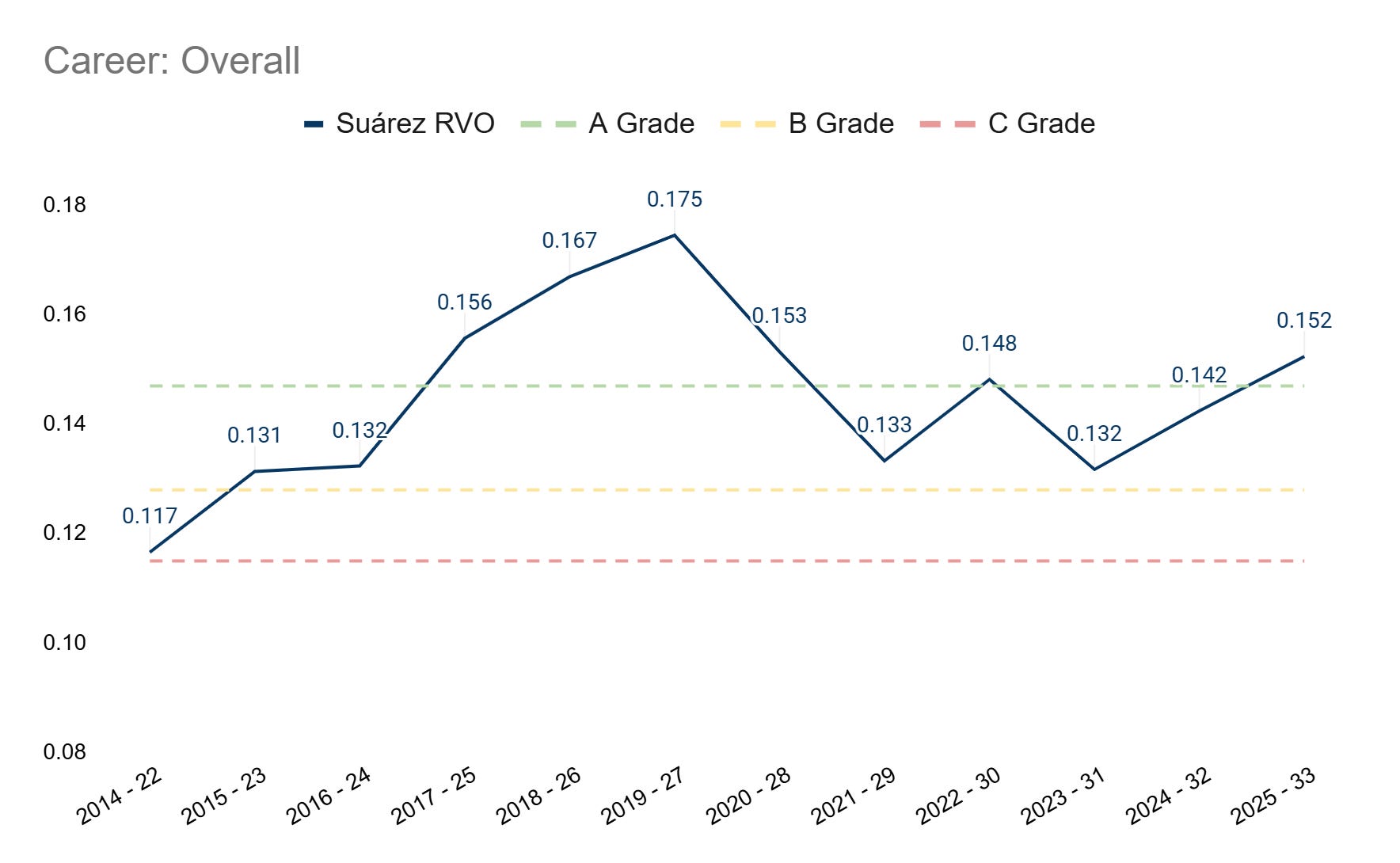
From a Overall production basis, he checks out and has shown the ability to adjust and sustain production later in his career despite not utilizing his Run Tool. This is a professional hitter, with a proven track record to make adjustments and knows himself. I am confident in Suárez’s Production, Bat and his ability to make adjustments. Despite turning 34 in July, I do not foresee a major drop in production in 2026 without a material change occurring.
I am not a fan of the age, steadily decreasing production to CF/RF, dip in fielding % in 2025. I am a fan of his ability/desire to post everyday (3-Year 97%), ability to hit the fastball, pull side pop, his overall production and the adjustments he’s able to make with his Hit Tool. I see Suárez as a good fit in a ballpark that can maximize his pull side power.
I believe a good comp in terms of what you can expect to get moving forward is Evan Longoria. They have similar production, not super high bat speed guys, both stand tall at the plate, loose with a tension free barrel.
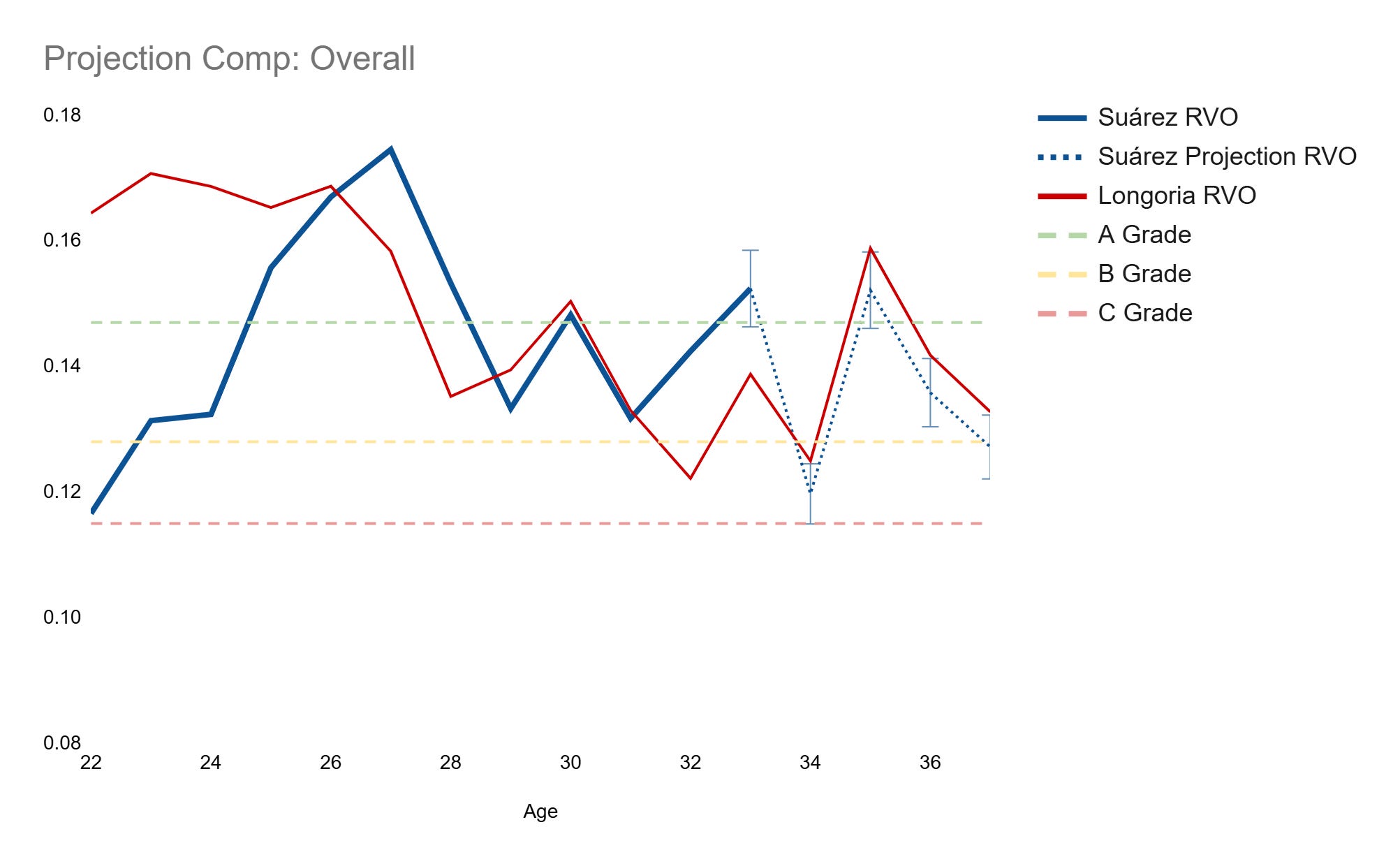
If Suárez follows a Longoria type trajectory, then you are looking at a hitter between B Grade to A Grade for 3B. Longoria games played did take a hit in his age 34 season.
I am generally not going beyond a 1 or 2 years for players above age 34-35 years old, but here’s where I would be comfortable at - if you have a good ballpark fit and need at 3B/DH/1B.
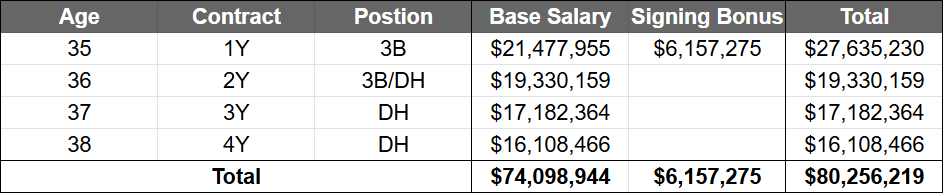
If you go 1 year then you probably have to go closer to market. Beyond 1 year, you start paying for the player you think you are going to get more of an aging B-A Grade DH/1B, who wants to post everyday. I believe in the bat and his ability to make adjustments, determination to play everyday and limited injury history. Do your other due diligence obviously, but for a team with Positional and Ballpark fit I could see this at $20,064,055 AAV, I think that gets the deal done. He ‘knows thy self’ and his success is not built on the back of ludacris bat speed. If he spends more time being a full time DH, you could also see more of the high end of his production.
Ballpark/Positional Fits
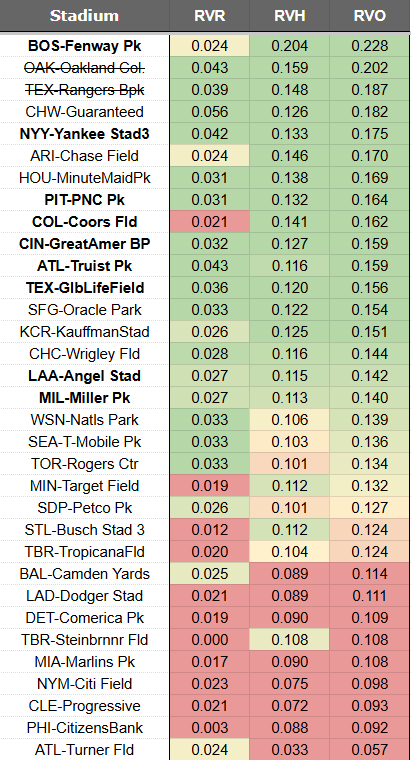
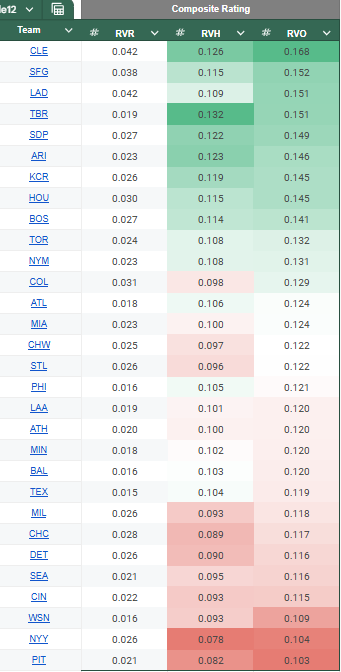
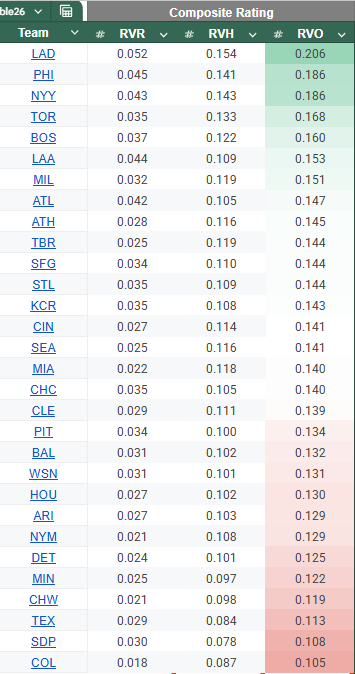
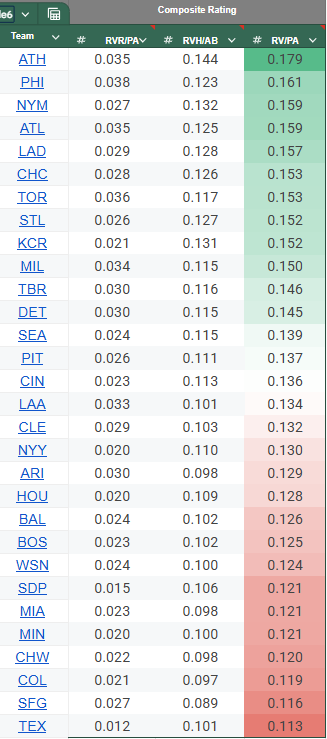
Ballpark Fit: BOS, NYY, CHW, ARI, HOU, PIT, COL, CIN, ATL, TEX, KCR
Positional Fit at 3B: PIT, NYY, WSN, CIN, SEA, DET, CHC, MIL, TEX, BAL
Positional Fit at DH: COL, SDP, TEX, CHW, MIN, DET, NYM, ARI, WSN, PIT
Positional Fit at 1B: TEX, COL, CWS, MIN, MIA, SDP, WSN, BOS, BAL, ARI
Teams Losing a 1B/3B to FA or Trade: BOS (Bregman), TOR (Bichette), SEA (Suárez), NYY (Goldschmidt), NYM (Alonso)
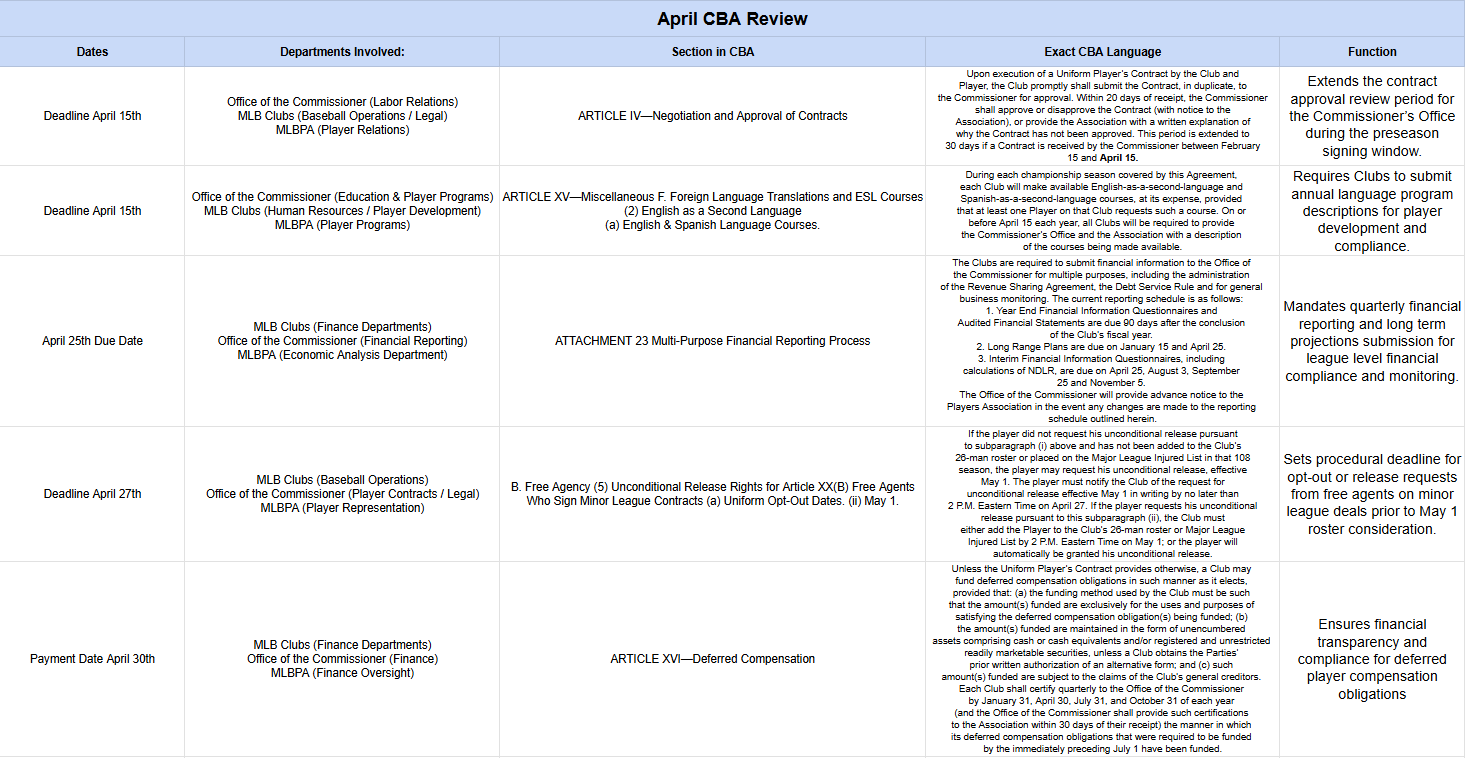
CBA Review - April
If you have made it this far don’t forget to subscribe and follow me on Twitter | LinkedIn | Medium | IG | TikTok. If you loved or hated this blog, let me know as well, but remember 3 ups & 3 downs. Give me 3 things you liked followed by 3 things you hated.
Stay Ahead of the Curve with Bozzy Baseball Blogs!
- Chris Bzozowski ’s Bozzy Baseball Blogs
Failure to plan is planning to fail. Remain resolved in your pursuits.
For more Bozzy Baseball Blogs…
Amateur Scouting Reports:
Trevor Cohen (Rutgers): identified as “Corbin Carroll-esque”; later drafted 85th by San Francisco. Published March 29, 2025
James Quinn-Irons (GMU): projected as a Grichuk-type profile; later drafted 147th by Tampa Bay. Published April 27, 2025
Professional Scouting Reports:
Cody Ponce: Scouting Report and evaluation ‘GM/Front Office Game Plan – 2-3 Year Contract Outlook - Depending on what your team relays to you in terms of their expectations on timelines to improve these mechanical/stamina issues, a 2-3 year investment could makes sense, provided there’s a commitment from both player and organization to mechanical adjustments, conditioning, and development support. Two potential approaches emerge…’ Published Aug 25, 2025. Toronto Blue Jays signed Ponce on a 3 year/ $30 mil contract on 12/11/25
Kyle Stowers (Norfolk): “Stowers… can hit this caliber pitching especially with his approach consistently. I think he needs an opportunity with a big club to see if he can translate his first at bat approach to next level caliber pitching.” Published Jul 29, 2024. Stowers AS in 2025 .288/.368/.544
Sung-Mun Song was identified in Bozzy Baseball Blog’s bi-weekly KBO Rates & Ranks Report as a great producer (5th best in KBO). He was featured in nearly every bi-weekly KBO R&R Report. He even reached elite production in R&R Report #9… On 12/19/25 signed with the San Diego Padres
Free Agent Evaluations:
Kyle Schwarber – ‘Ultimately when it’s all said and done, I think you could see a +10%-15% bidding debit + State & Local Income taxes debit applied to a market price. Max market + max debit could put this around $29.2M AAV / 4 years. I think you will see teams jump at the opportunity to compete for an elite producer when they know the Dodgers and Yankees are not in the equation. Additionally, when teams like the Phillies and Mets are tied to a couple aging contracts, you start to see a window where teams extend on the years to put this one over the top’ Published Nov 3, 2025 … Philadelphia Phillies signed for 5 years, 30 Mil AAV on 12/9/25
Ha-Seong Kim –‘ There are injury concerns here, I think he could get $15,653,069.18 AAV over 3-4 years. A team with availability at 2B after Y2 would be preferable. In all, not much has changed from my eval from last year. I like the growth of the bat with the Braves, tells me he’s willing to evolve a bit. I’m comfortable with 3Y/$46,959,207.53 if I had a need at SS or 2B…The natural fit is to say he’s going to go back to the Braves. They seemed to work pretty well together, and they need a SS.’ Published Dec 15, 2025… Atlanta Braves signed for 1 year, $20 Mil on 12/15/25
Kyle Tucker, Pete Alonso, Alex Bregman, Bo Bichette, Munetaka Murakami, Luis Arráez
Tyler O’Neill: ‘Predicted fit/value with Orioles; Contract Recommendation : the deal is 50% ($7.8 mil) guaranteed, which is what you are expecting him to play, then an additional ($1.56 Mil) for each additional 10% GP. $7.8 Guaranteed, $7.8 in games played Incentives or 2 years/$18.72 Mil.’ Published Nov 17, 2024… Signed with Orioles on 12/7/2024 for 3 years/$49.5Mil… In 2025, O’Neill played in 33% of Orioles games.
Jurickson Profar: “Given Profar’s profile at 32, I’d recommend a 1-year, $6.75 million deal, with the possibility of a 2-year, $14 million deal for a team that views him as a complementary piece in an already established lineup. While his on-base skills are appealing, I’m not buying into the slugging breakout, especially given the stark home/away splits’ Published 11/23/24…On 1/23/25 Profar signed with the Braves for three-years, $42 million. On 3/31/25 Profar received an 80-game suspension
MLB Analysis:
Phillies – Predicted how the Phillies might manage veteran workloads, such as placing Bryce Harper on the IL and highlighted Otto Kemp as a likely call-up. Published May 28, 2025
Orioles: Post-deadline recap with roster strategy analysis. Published July 31, 2025
Free Agent Valuation Tool :
Harrison Bader: Valuation tool: $6.3–8.5M; final deal $6.25M + $2M in incentives
Kiké Hernández : Valuation tool: $5.4–$7.6M. final deal : $6.5M